
AI Needs a Flight Recorder: Why Runtime Evidence May Become a Foundational Layer for Long-Horizon AI
“The Evidence Series · 01 ”

For decades, aviation has relied on a simple principle: When something goes wrong, preserve the evidence.
Commercial aircraft carry flight recorders so that an incident does not have to be understood through memory, intention, or speculation alone. These systems continuously preserve defined streams of operational data across ordinary flights, minor deviations, unexpected conditions, successful recoveries, near misses, and major failures.
When investigators examine that record, they are not asking what the aircraft was designed to do or what its operators intended to happen.
They are asking what the available evidence shows occurred:
When did the first observable problem appear?
What changed before the incident?
Which warnings were present?
Which signals were missed?
Which interventions were followed by recovery?
Which interventions failed to change the trajectory?
Were earlier opportunities for intervention visible in the record?
The flight recorder does not preserve total reality. No instrument does. It preserves an evidentiary record—a bounded account of the parameters and events it was designed to capture.
That record changes the nature of an investigation. It allows competing explanations to be tested against something more durable than recollection.
As artificial intelligence becomes more autonomous, persistent, and deeply integrated into consequential workflows, a similar question is emerging:
“Where is the flight recorder for AI?”
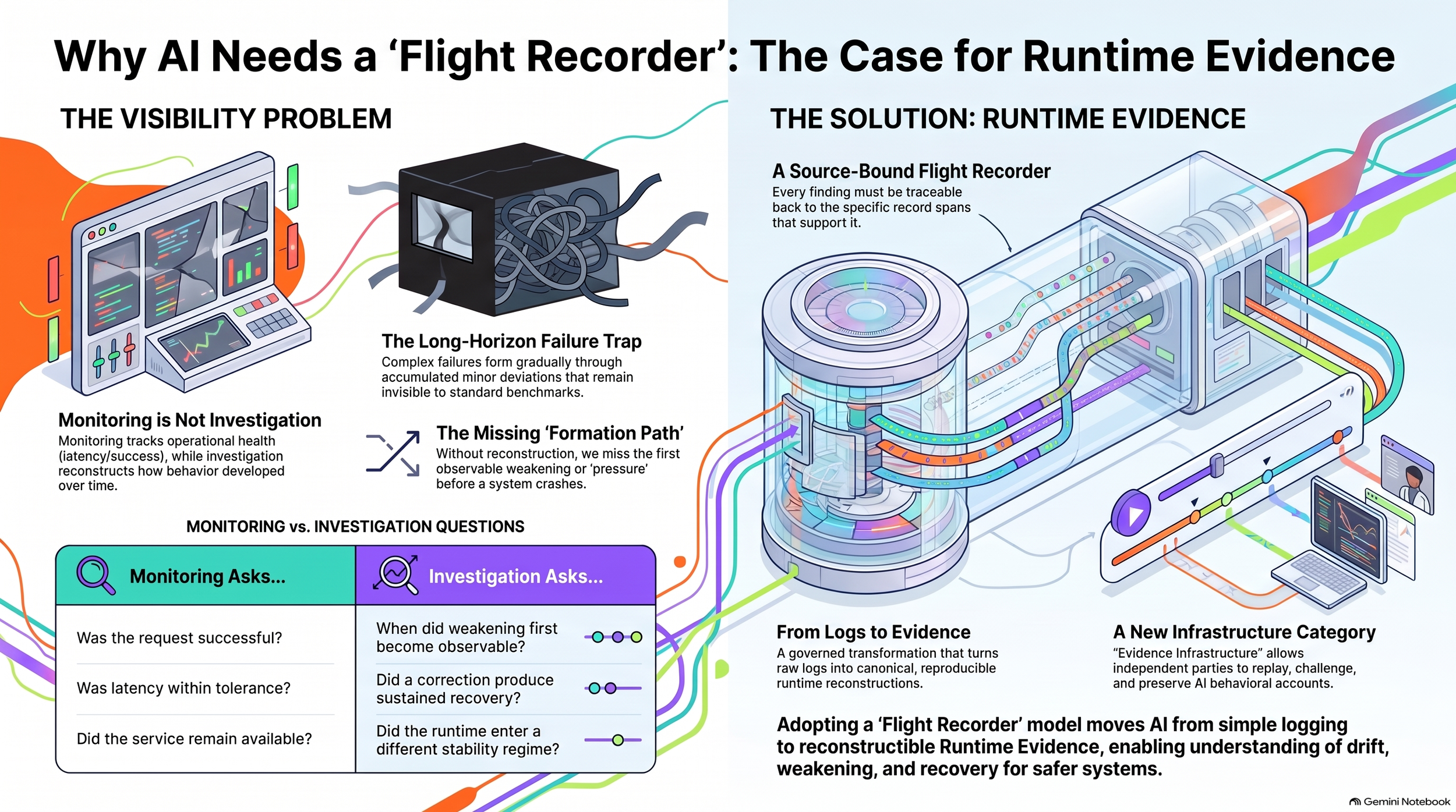
The Visibility Problem
Most AI systems operate inside a peculiar form of visibility.
We can record inputs and outputs. We can measure latency, cost, token consumption, request success, tool calls, errors, and benchmark performance. In sophisticated systems, we may also retain traces, agent events, retrieval activity, workflow state, and human interventions.
Yet when a long-running system fails, those records do not automatically explain how the failure developed.
Imagine an AI system coordinating research, software development, customer support, logistics, security operations, healthcare administration, or financial workflows. After hours or hundreds of interactions, the result is clearly wrong.
The immediate question is: What happened?
The answer is rarely contained in the final output alone.
Long-horizon failures may form gradually. A minor deviation changes the conditions inherited by the next step. An incorrect summary propagates. A tool result is misunderstood. A correction appears to work but fails to persist. Conflicting objectives accumulate. Coordination weakens while each individual response remains plausible.
By the time failure becomes visible, its earliest observable precursors or contributing conditions may lie far earlier in the runtime.
The events may have been recorded. What is often missing is the architecture required to reconstruct the relationships among them.
Monitoring Is Not Investigation
Monitoring and investigation are related, but they are not the same discipline.
Monitoring asks:
Was latency acceptable?
Did the request succeed?
Was throughput healthy?
Were infrastructure errors within tolerance?
Did the service remain available?
These are essential operational questions.
Investigation asks something different:
When did weakening first become observable?
Did drift accumulate relative to a declared reference?
Did the runtime enter a different stability regime?
Was an observable boundary crossed under the specified method?
Did a correction produce sustained recovery or only temporary improvement?
Which roles, tools, and events accompanied the transition?
What evidence supports each finding?
Where must the resulting claims stop?
A monitoring platform may capture many of the relevant events without reconstructing the process connecting them. It can show that infrastructure remained healthy while leaving unresolved how observable behavior changed across the runtime.
Monitoring records what occurred.
Runtime reconstruction examines how it developed.
Evidence determines what can responsibly be claimed.
The Missing Layer Between Benchmarks and Monitoring
AI systems are commonly assessed through two broad approaches.
The first is evaluation: can the system perform a task, satisfy a rubric, or produce an acceptable output?
The second is observability: is the deployed system operating, and what technical events occurred while it ran?
Between them lies another object of study: longitudinal computational behavior.
This is not simply a long transcript. It is the observable development of a computational system across an ordered runtime: how outputs, actions, constraints, roles, tool results, corrections, and prior events condition what happens next.
A single response can be evaluated as an output. A trajectory must be reconstructed as a temporal and dynamical object.
That trajectory can contain forms of organization that are not meaningful at the level of one isolated event:
persistent drift;
recurring behavioral configurations;
coordination changes between roles;
accumulating pressure;
regime transitions;
boundary formation;
failed correction;
sustained recovery.
The missing layer is therefore not another dashboard. It is an evidentiary architecture for turning operational records into an inspectable account of behavior through time.
The Formation Path
A flight recorder matters because a major incident is only one possible outcome of the trajectory it records.
The same record may contain normal operation, small anomalies, changing conditions, warning signals, corrective action, and successful recovery. The value lies not only in examining the terminal event, but in preserving the path that preceded it.
The same principle applies to intelligent systems.
If investigation begins only after a visible failure, it may miss the process that produced it. The scientifically interesting object is often the formation path:
the first observable weakening;
the first persistent displacement;
the accumulation of unresolved pressure;
the transition into a materially different regime;
the boundary beyond which earlier organization was no longer sustained;
or the sequence through which coherent operation was recovered.
The outcome matters. But the trajectory explains what the record permits us to say about its development.
Runtime Behavior Can Become Evidence
This is the central proposition of Runtime Evidence:
Observable runtime behavior can become reconstructable evidence.
Instead of treating interactions as transient events, Runtime Evidence treats available operational records as source material from which a bounded runtime account may be constructed.
The flight-recorder function begins with reconstruction rather than prediction. A completed or captured runtime becomes something that can be replayed, measured, inspected, challenged, and preserved.
Within that record, an investigator may be able to examine:
when particular conditions became observable;
how displacement or pressure accumulated;
when a declared boundary was crossed;
which interactions accompanied a transition;
whether correction persisted;
what evidence remains unavailable;
and which conclusions the record does not support.
This does not make every interpretation true. It creates the conditions under which interpretations can be traced back to evidence and tested against explicit methods and limits.
From Operational Records to Runtime Evidence
Logs are records. They do not become evidence-bearing reconstructions merely by being collected.
A defensible runtime investigation requires a governed transformation:
Operational Record
↓
Source Qualification and Canonicalization
↓
Current Evidence Run
↓
Runtime Reconstruction
↓
Instrument Findings
↓
Guided Investigation
↓
Evidence Record Formation
↓
Sealing and Preservation
Each stage answers a different question.
Was the source sufficient for the requested reconstruction? How were roles and events normalized? Which runtime object governed computation? Which measurements were authorized? What did the instruments find? What source spans support those findings? What remains missing? What can be preserved and reproduced?
The governing principle is simple:
No claim should exceed the authority of its evidence.
Aperture: A Runtime Evidence Observatory
This philosophy became the foundation for SubstrateX Aperture™.
Aperture is not a benchmark platform, conventional monitoring system, or collection of independent analytics dashboards. It is a Runtime Evidence Observatory designed to reconstruct and investigate long-horizon computational behavior from observable operational records.
An operator supplies a log, transcript, trace, incident stream, workflow artifact, or other supported record. Aperture qualifies the source, preserves its provenance, constructs a canonical runtime, and establishes a Current Evidence Run as the shared computational authority.
From that same authorized runtime, Aperture can reconstruct worldlines, roles, events, regimes, temporal markers, boundaries, and recovery posture. Its scientific instruments project bounded findings onto the shared reconstruction. Guided Investigation connects questions to those findings and then back to the source evidence that supports them.
The result is a practical computational flight recorder and reconstruction system for AI interactions.
Not because it records hidden thoughts.
Not because it claims access to inaccessible internal model states.
And not because a reconstruction proves cause, intention, or truth.
Aperture operates by preserving a traceable chain between observable records, declared methods, computed findings, interpretations, and explicit claim boundaries.
Record the runtime. Reconstruct the trajectory. Trace every finding back to evidence.
Why Long-Horizon AI Changes the Requirement
Short interactions can often be evaluated one response at a time. Long-horizon systems are different.
They may operate across hundreds or thousands of events, multiple agents, human participants, external tools, extended planning cycles, dynamic environments, and objectives that evolve during operation.
Under these conditions, behavior becomes path-dependent. Later events inherit the effects of earlier ones. A small departure can alter the next decision; that decision can reshape the context inherited by everything that follows.
Failure may therefore appear sudden while having a much longer observable formation history.
Without reconstruction, investigators are left with fragments: a final output, scattered logs, operational metrics, and retrospective explanations. With a source-bound runtime reconstruction, those fragments can be examined as parts of one developing trajectory.
That does not guarantee that the available record is complete. It makes incompleteness visible—and prevents unsupported certainty from filling the gap.
Evidence Instead of Retrospective Storytelling
The most important contribution of the aviation flight recorder was not only technical. It helped establish a culture in which incidents could be reconstructed from preserved records rather than explained solely through confidence, authority, or memory.
Long-horizon AI requires a comparable shift.
Instead of asking only:
What do we think happened?
we must also ask:
What does the available record support?
That transition requires evidence that is:
source-bound;
reproducible under declared methods;
inspectable;
replayable;
challengeable;
explicit about missing information;
bounded in what it permits us to claim;
and preservable beyond the immediate investigation.
The objective is not to eliminate interpretation. It is to prevent interpretation from becoming detached from the record.
A New Category of Infrastructure
Runtime Evidence points toward a distinct category of AI infrastructure.
Not training infrastructure.
Not inference infrastructure.
Not monitoring infrastructure.
Evidence infrastructure.
Infrastructure designed to answer:
What observable behavior developed?
How was its trajectory reconstructed?
When did material changes become visible?
Which measurements and methods support the findings?
What evidence is missing?
Can another investigator reproduce or challenge the account?
Can the record be preserved without separating its conclusions from their provenance?
These questions become more important as intelligent systems move from isolated interactions into persistent operational environments.
Capability tells us what a system may be able to do.
Monitoring tells us whether the surrounding service is operating.
Runtime Evidence provides a disciplined account of how observable behavior developed through time.
The Future
Aviation became safer because incidents could become durable objects of investigation. Evidence could be retained, methods improved, and lessons carried into future systems.
AI will need the same capacity—not an imitation of aviation instrumentation, but an equivalent commitment to preserving and reconstructing consequential behavior.
We may eventually look back and ask:
How did we operate intelligent systems for so long without a runtime flight recorder?
Runtime Evidence is an attempt to answer that question before the need becomes undeniable.
The most consequential innovation may not always be a more capable model. It may be the infrastructure that allows us to understand what occurred after the interaction is over, determine what the record supports, and preserve that account for independent examination.
Because accountability begins where memory becomes insufficient.
And evidence begins when reconstruction remains answerable to the record.
Article Record
Central Proposition
Long-horizon AI requires the computational equivalent of a flight recorder: an evidence infrastructure capable of transforming observable operational records into source-bound runtime reconstructions through which trajectories, transitions, findings, and their supporting evidence can be inspected, challenged, reproduced, and preserved.
Relationship to the Canonical Work
This article provides a public introduction to Runtime Evidence and its operational expression through SubstrateX Aperture™.
It connects the scientific study of Longitudinal Computational Behavior with the engineering requirements of runtime reconstruction, Guided Investigation, evidence authority, claim boundaries, and preservation. The article introduces the problem and governing metaphor; it does not replace the formal definitions, standards, or computational contracts established in the canonical work.
Aperture’s Runtime Blackbox provides the principal operational expression of the flight-recorder concept described here.
Source and Research Basis
The article synthesizes Arjay Asadi’s research into Recursive Science®, Longitudinal Computational Behavior, Runtime Intelligence, Computational Behavior Architecture, Runtime Evidence, and Evidence-Governed Computation™, together with the implemented architecture of the Aperture Runtime Evidence Observatory. The aviation flight recorder serves as an explanatory analogy. Aperture is not an aviation instrument, and the article does not claim technical equivalence between aircraft recording systems and AI runtime reconstruction.
Limits and Open Questions
A runtime reconstruction does not preserve total reality. Its authority remains limited by the coverage, integrity, ordering, provenance, and compatibility of the supplied operational record.
Aperture does not recover hidden reasoning, private chain-of-thought, internal model state, intention, consciousness, or definitive cause from output-level evidence. It reconstructs relationships supported by observable operational records. Deterministic reconstruction establishes that the same qualified source, method, and version can produce the same evidence object. It does not independently establish scientific validity, objective truth, safety, or causal certainty.
Boundary crossings are computed under declared observable methods. Formal Lead-Time is admissible only when both a qualifying boundary marker and an observable failure marker are available. Retrospective precursor relationships require prospective validation before they can support calibrated forecasting.
Open research questions include:
What minimum record coverage is required for a defensible runtime reconstruction?
Which source families can be reliably mapped into a shared canonical runtime?
Which longitudinal measurements remain stable across models, agents, tools, and operational environments?
How should incomplete, contradictory, or privately held records constrain an investigation?
Which precursor relationships generalize under prospective testing?
How can runtime evidence be preserved and compared without exposing protected source material?
What standards are required for independent reproduction across organizations and platforms?
Related Foundations
Preferred Citation
Asadi, Arjay. “AI Needs a Flight Recorder: Why Runtime Evidence May Become a Foundational Layer for Long-Horizon AI.”
https://www.arjayasadi.com/ai-needs-a-flight-recorder.
© 2026 Arjay Asadi. All rights reserved.