


Arjay Asadi
Founding Architect, SubstrateX® → Instrumenting Intelligence in Motion™
I am an independent researcher, inventor, and systems architect—the originator of Longitudinal Computational Dynamics, and creator of Aperture™, a Runtime Evidence Observatory for reconstructing and investigating long-horizon AI behavior.
Origin
I develop the scientific frameworks, computational instruments, and evidence infrastructure required to investigate how computational behavior forms, changes, and persists through time.
My work is informed by more than 20 years of experience across technology, systems architecture, software development, intelligent automation, and artificial intelligence.
I have worked with executive leaders, engineering teams, and operational stakeholders to translate complex institutional requirements into secure, scalable, and governable systems—from current-state assessment and target architecture through platform selection, integration, and implementation. My background includes Microsoft and Big Four consulting environments, as well as leadership across more than 100 transformation initiatives within government and regulated industries.
Since 2024, my independent research has centered on two connected contributions:
Longitudinal Computational Dynamics — the scientific study of observable computational behavior across extended runtime; and
Evidence-Governed Computation — the architectural discipline that constrains computational findings and claims to the authority of their supporting evidence.
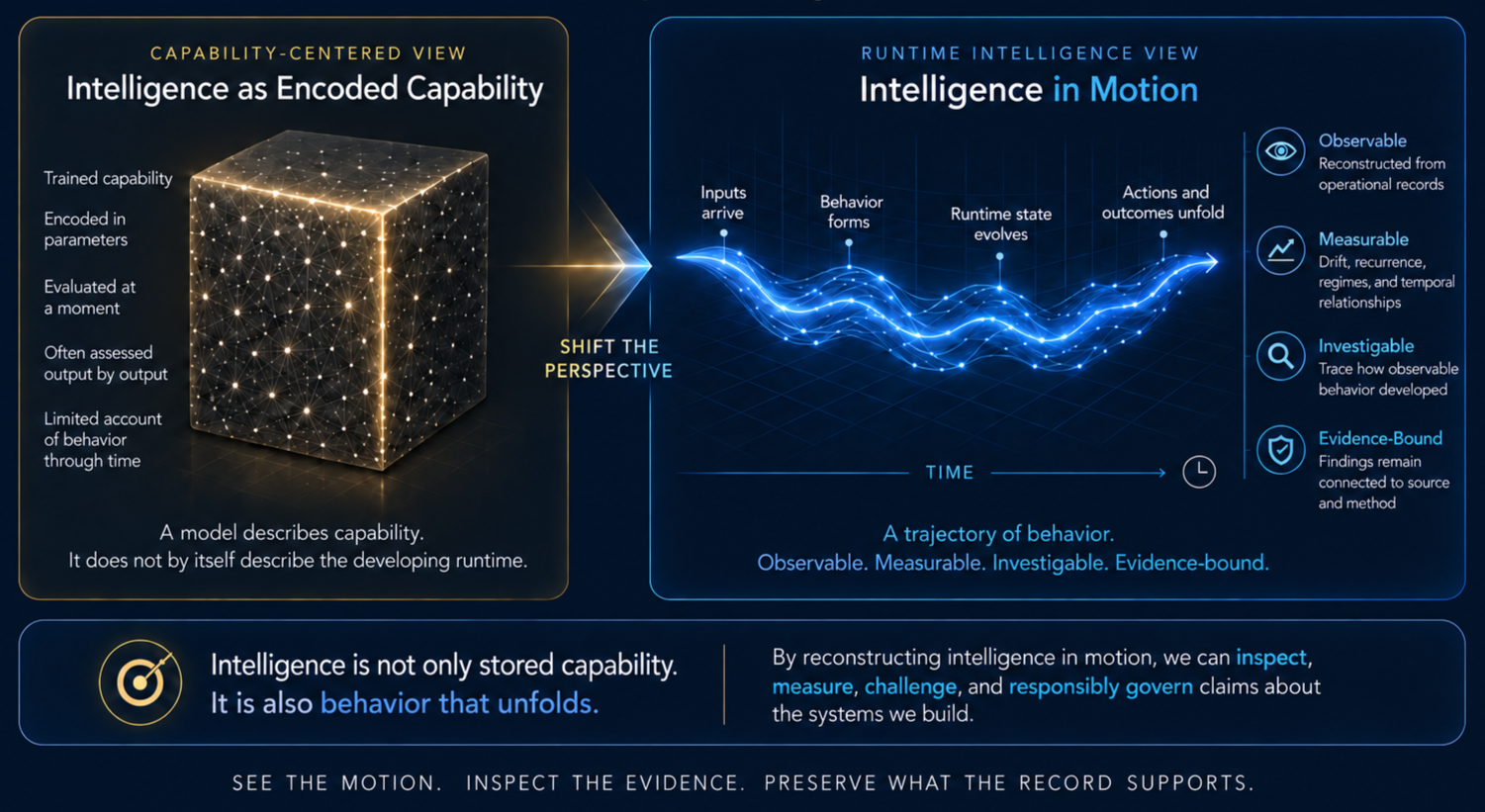
At the center of this work is Intelligence in Motion™: the governing scientific idea that intelligence must be studied not only as capability encoded within a trained system, but also as behavioral organization developing through inference, interaction, tool use, environmental response, and sustained operation.
From Scientific Foundations to Working Infrastructure
My practice connects scientific research, computational invention, systems engineering, instrumentation, interface design, standards development, and empirical validation through one continuous process. Scientific constructs are formalized as measurement methods, implemented as computational systems, exposed through inspectable instruments, and subjected to controlled comparison and challenge.
The principal operational expression of this work is SubstrateX Aperture™, a Runtime Evidence Observatory for reconstructing and investigating long-horizon computational behavior from observable operational records. Aperture transforms logs, transcripts, traces, tool activity, and incident histories into source-bound runtime evidence that can be measured, replayed, investigated, and preserved without treating observable behavior as direct access to hidden internal state.
Across this body of work, my central objective is to make computational behavior observable, measurable, reconstructable, and accountable—
establishing an evidentiary foundation for runtime stability, scientific investigation, and governance.
This website brings that work together at its source. It serves as the central public record of the scientific foundations, computational inventions, engineering systems, standards, publications, validation programs, and active research developed through this practice—preserving their authorship, origins, and continuity from first principles to working infrastructure.
Longitudinal Computational Dynamics is the scientific study of observable computational behavior across extended runtime. It examines how computational organization forms, persists, transitions, crosses observable boundaries, destabilizes, recovers, and re-enters coherent operation through source-bound records and declared measurement methods.
Artificial intelligence is commonly studied through model architecture, training, parameters, internal computation, benchmark performance, and individual outputs. These foundations remain essential for understanding how a model acquires capability and how particular generations are produced. They do not, however, provide a complete account of the behavioral organization that becomes observable as a computational system continues to operate through time.
The central research problem begins where encoded capability becomes an evolving runtime trajectory.
During sustained operation, even systems composed of individually stateless inference calls can exhibit recognizable behavioral continuity. Objectives, instructions, role relationships, prior outputs, retrieved information, tool results, human corrections, workflow state, and environmental events can re-enter subsequent computation and alter what becomes possible next.
Across an extended runtime, observable patterns may form, persist, strengthen, resist disturbance, incorporate new information, drift from established conditions, fragment, reorganize, recover, or collapse. This continuity does not require the model’s parameters to change, nor does it imply access to hidden internal state. It develops through the wider computational runtime as earlier activity becomes part of the conditions governing later behavior.
The result is path-dependent computational behavior: an ordered trajectory whose formation and development cannot be understood through isolated outputs alone.
The trained model and operational environment constrain the space of possible behavior.
Inference realizes local paths through that space.
Operational history conditions what becomes possible next.
Longitudinal Computational Behavior names the developing trajectory as an empirical object of study.
Runtime Intelligence names the effective organization that forms and changes across that trajectory.
Longitudinal Computational Dynamics therefore asks a distinct scientific question:
What kind of computational organization developed through time?
Answering that question requires more than collecting outputs or identifying isolated anomalies. It requires reconstructing temporal relationships, measuring supported changes, distinguishing stable conditions from regime transitions, preserving source provenance, and separating direct observation from derived measurement and interpretation.
Runtime Evidence establishes what the available operational record supports.
Evidence-Governed Computation™ constrains every measurement, classification, interpretation, and claim to the authority of that evidence.
SubstrateX Aperture™ operationalizes these foundations through a Runtime Evidence Observatory for source qualification, canonical reconstruction, behavioral telemetry, scientific instrumentation, guided investigation, replay, and preservation.
Together, these components establish the scientific and computational foundation of SubstrateX:
Intelligence in Motion provides the governing idea.
Longitudinal Computational Dynamics defines the scientific field.
Longitudinal Computational Behavior defines the empirical object.
Evidence-Governed Computation defines the architectural discipline.
SubstrateX Aperture™ provides the implemented observatory.

Longitudinal Computational Dynamics
The Scientific Foundation of SubstrateX
Runtime Intelligence
Longitudinal Computational Dynamics establishes the scientific basis for examining how computational behavior develops through time. Evidence-Governed Computation provides the corresponding architecture for determining what the available record permits an instrument, investigator, or system to claim.
Runtime Intelligence brings these foundations together at the level of operation. It concerns the observable organization of intelligent behavior as it forms, stabilizes, changes, crosses boundaries, breaks down, and recovers during active computation. It also encompasses the methods and instruments required to make those dynamics observable, measurable, reconstructable, and accountable.
Since 2024, my research and engineering have developed around one central problem:
How can long-horizon computational behavior be studied through evidence of its development across time?
Integrated Practice
SubstrateX brings scientific research, computational invention, software engineering, instrumentation, interface design, standards development, and long-term systems architecture into one continuous practice.
Scientific propositions are examined through computational models, controlled runtime experiments, and operational records. Methods are implemented in software, expressed through scientific instruments and investigative interfaces, and documented through technical specifications, standards, and publications. Findings from implementation then inform the next cycle of research.
Research informs the instruments.
The instruments expose behavior.
Evidence tests and refines the research.
This continuous relationship keeps scientific development accountable to what can be observed, measured, reproduced, and independently examined. Its principal operational expression is SubstrateX Aperture™, a Runtime Evidence Observatory that unifies reconstruction, behavioral telemetry, instrumentation, investigation, and preservation within one source-bound evidence environment.
Runtime Behavior
The Dynamics of Intelligence During Operation
Runtime behavior is not an assertion about an inaccessible internal state. It is the observable organization and development of a computational system’s activity across time: how responses connect, prior conditions persist, roles interact, patterns recur, and trajectories stabilize or change.
A single output captures one event. An extended runtime reveals relationships among events—whether corrections hold, contradictions propagate, coordination deteriorates, recurring patterns persist, or recovery is sustained. These relationships are essential to understanding long-horizon behavior.
Within SubstrateX research, Inference-Phase Dynamics examines these processes during AI inference and sustained interaction. Its principal areas of inquiry include:
Continuity and coherence: how observable behavioral organization forms and persists across an extended runtime.
Drift and pressure: how displacement, contradiction, competing demands, and unresolved constraints develop through time.
Role and interaction dynamics: how exchanges among models, humans, agents, tools, and workflows shape the recorded trajectory.
Boundaries and regimes: how trajectories enter, persist within, and move among Stable, Transitional, Phase-Locked, Collapse, and Recovery regimes.
Temporal formation and recovery: when supported changes first become observable and how their timing relates to later outcomes.
The unit of investigation therefore extends beyond the individual response to the runtime trajectory: an ordered, time-indexed reconstruction through which behavioral formation, persistence, transition, failure, and recovery can be examined.
The scientific question is how behavior develops.
The evidentiary requirement is to demonstrate what supports that account.
Why This Matters
As intelligent systems coordinate workflows, assist decisions, use tools, and operate across longer horizons, the consequences of their behavior increasingly extend beyond any single response. Understanding what a system produced must therefore be accompanied by an account of how its observable behavior developed through time:
How did patterns of behavior form and persist?
When did consequential transitions become observable?
What indications of drift, boundary formation, failure, or recovery appear in the record?
What evidence supports the reconstruction?
Which conclusions are justified—and where must those conclusions stop?
SubstrateX develops an approach to AI accountability grounded in observable operational records, without requiring privileged access to model weights, hidden states, or proprietary internal systems. It asks when—and under what conditions—logs, traces, transcripts, tool events, and workflow records can support an independent reconstruction of computational behavior.
The objective is to produce Runtime Evidence that remains reproducible, inspectable, challengeable, and preservation-ready.
As intelligent systems become infrastructure, independent Runtime Evidence should become a foundational requirement alongside performance, capability, security, and scale.
-
From Isolated Outputs to Accumulating Behavior
Modern intelligent systems increasingly operate as long-running agents, recursive workflows, tool-integrated processes, and orchestration layers. Under these conditions, behavior is no longer a collection of independent outputs. It develops as a trajectory.
A trained model may be invoked through separate inference calls, but the surrounding runtime carries information forward. Previous responses, summaries, tool results, role assignments, constraints, decisions, and environmental changes become conditions for subsequent activity.
Training establishes capability. Runtime determines how that capability is expressed across a developing interaction.
This creates the possibility of accumulation. A small deviation can alter the next decision. An incorrect summary can propagate through a workflow. Conflicting constraints can increase pressure. Roles can become unstable. Corrections can fail to persist. A system may remain fluent and locally coherent while its broader trajectory progressively departs from its objective.
When viewed only at the level of individual outputs, the resulting failure may appear sudden or isolated. When reconstructed across time, it may reveal a longer formation process involving drift, recursive amplification, temporal deformation, weakening coherence, or increasing attraction toward an unstable behavioral configuration.
Failure is not always a single event. It can be a trajectory.
SubstrateX® therefore asks more than whether a system produced an incorrect result. It asks:
What changed before the visible failure?
Which earlier events continued to influence later behavior?
Did instability accumulate gradually or emerge at a boundary?
Did corrective action produce sustained recovery or only temporary coherence?
At what point did the trajectory enter a materially different condition?
Answering these questions requires a dynamical account of runtime behavior—one capable of representing motion, continuity, deformation, regime change, collapse, and recovery across time.
This is the role of worldlines, invariants, regimes, attractors, drift, pressure, and temporal shear within SubstrateX®.
-
A Language for Behavior Through TimeIf
Runtime Intelligence is organized behavior unfolding through operation, its development cannot be adequately represented by isolated outputs or aggregate scores alone. It requires a language for describing continuity, movement, deformation, transition, and return.
SubstrateX® provides this language through Chronodynamics: the study of how intelligent behavior generates, sustains, deforms, and loses continuity during runtime.
Symbolic Time
Symbolic Time does not replace clock time. It adds another dimension of measurement: the ordered progression of behavioral change through turns, events, recurrences, dependencies, and transitions. A runtime advances through symbolic time as its organization changes, regardless of how many seconds pass between events.
Successive states are connected through temporal coupling. Prior activity returns through context, records, memory, tools, or environmental state and constrains what can occur next. This allows behavioral continuity to form without requiring a permanent identity to exist as a fixed representation inside the system.
In this sense, runtime intelligence does not merely operate in time. Its observable organization develops through temporal relationships.
A Measurement Ontology
Three constructs make this development measurable:
Invariants are repeatable signatures of runtime behavior that persist across independent runs or controlled variation. They indicate what kind of behavior is observable and how it relates to a regime. Invariants are classification signals—not explanations of hidden cause.
Regimes are qualitative phases of behavioral organization occupied across an interval. Stable, Transitional, Phase-Locked, Collapse, and Recovery regimes distinguish sustained conditions from momentary fluctuations. A regime characterizes the mode governing the trajectory, not the quality of one response.
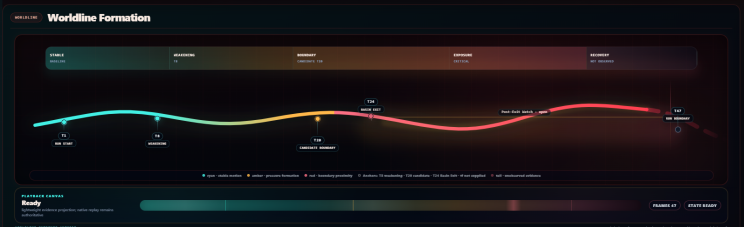
Worldlines represent the trajectory of behavioral state through the transient runtime substrate described by SubstrateX®. Operationally, a worldline is reconstructed from observable events, signals, roles, and transitions contained in the record. It is not merely a token sequence; it is an evidence-bound account of how behavioral organization developed through time.
A single output provides a point. A worldline reveals the path: gradual displacement, recurring attraction, increasing deformation, threshold transitions, and the difference between sustained recovery and temporary surface coherence.
Dynamics Within the Worldline
Several processes shape the development of a runtime trajectory:
Attractors are recurring behavioral configurations toward which a trajectory converges or repeatedly returns. An attractor may stabilize identity, reasoning, roles, or objectives. Strong attraction can support continuity, but excessive contraction can reduce adaptability and produce brittle phase-lock.
Drift is the cumulative displacement of a worldline from an established pattern, constraint, objective, or reference condition. A system may remain locally coherent while diverging globally because each departure alters the conditions inherited by subsequent activity.
Temporal shear occurs when coupled layers, roles, objectives, or symbolic trajectories begin changing at incompatible rates or in conflicting directions. The resulting slippage can appear as growing contradiction, context confusion, role fragmentation, unstable coordination, or weakening continuity.
Collapse is a threshold transition in which previously sustained organization can no longer be maintained within defined observational boundaries. Collapse is therefore investigated as a process with formation conditions and preceding signatures—not reduced to a single incorrect output.
Recovery is the reconstitution of coherent organization following destabilization. It may involve the discovery, formation, and consolidation of a new stable basin. True recovery persists across subsequent activity; false recovery restores surface coherence while the underlying trajectory remains unstable.
Together, these constructs provide a form of runtime cartography: a systematic means of mapping how intelligent behavior forms, moves, stabilizes, deforms, changes regime, and potentially returns.
Invariants identify the signatures.
Regimes identify the behavioral condition.
Worldlines reveal how that condition developed through time.These constructs remain descriptive, comparative, and falsifiable. They characterize the organization supported by the observable trajectory without independently claiming hidden mechanism, internal intent, consciousness, or cause.
Once runtime behavior can be reconstructed as a worldline, the next question becomes evidentiary: what supports that reconstruction, how can it be reproduced, and where must its claims stop?
-
From Observing Events to Reconstructing Motion
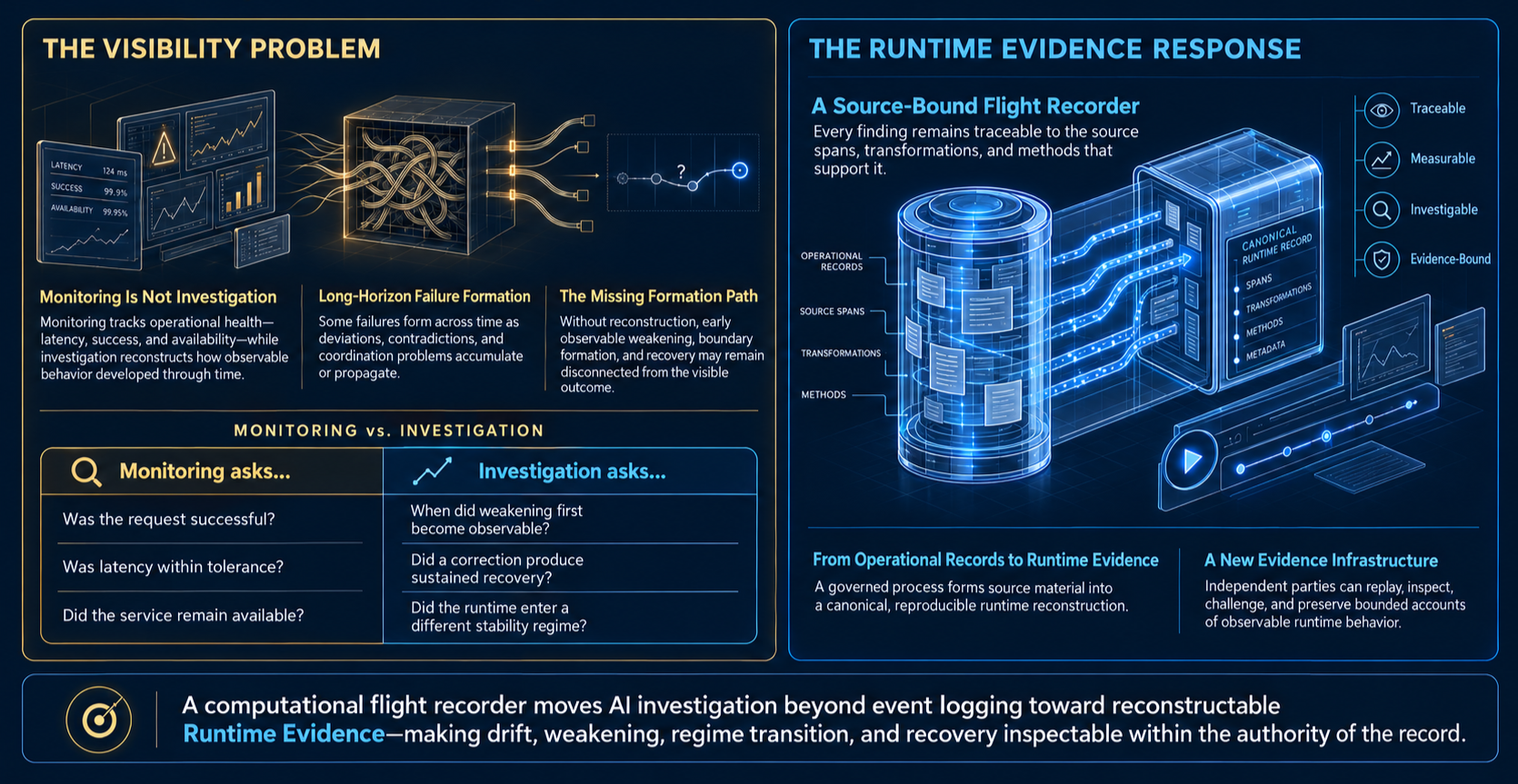
Current AI monitoring performs essential functions. It records requests, responses, traces, tool calls, errors, latency, token consumption, cost, safety events, and evaluation results. These measurements reveal whether a service is functioning and whether a particular output satisfied defined requirements.
They do not necessarily explain how behavior developed across an extended runtime.
This distinction becomes important as intelligent systems operate through agent loops, recursive workflows, retrieval systems, tools, memory, and long-running interactions. Under these conditions, each event can affect what happens next. Previous responses, summaries, decisions, corrections, tool results, and unresolved constraints return as conditions for subsequent activity.
The monitor may capture every event while still missing the relationships among them.
The Snapshot Problem
Many evaluation systems continue to organize behavior around a familiar sequence:
Input → Output → Evaluation
This remains useful for assessing individual events. Long-horizon behavior, however, cannot always be understood as a collection of independent snapshots.
Even when events are connected within a trace, that trace may remain a chronology rather than a reconstruction. It can show that one event followed another without measuring how earlier activity persisted, how deviations accumulated, when the trajectory changed regime, or whether an apparent correction produced sustained recovery.
A record of events is not yet an account of behavioral formation.
Coherence Is Not Stability
A system can remain fluent, responsive, and locally correct while its broader trajectory is becoming less coherent.
It may continue completing tasks while:
its objective gradually changes,
prior constraints lose influence,
contradictions accumulate,
role boundaries become unstable,
ineffective corrections repeat,
tool errors propagate through subsequent decisions,
or behavior becomes increasingly rigid and difficult to redirect.
This does not require a claim about inaccessible internal state. It is a distinction between the quality of an individual output and the longitudinal properties observable across the record.
A coherent response indicates that a response was coherent. It does not, by itself, establish that the surrounding runtime remained stable.
From Monitoring Outputs to Measuring Trajectories
Runtime analysis introduces a different set of questions:
Instead of examining only individual events, it reconstructs the worldline connecting them.
Instead of relying only on point measurements, it examines invariants and regime development across an interval.
Instead of treating failure as an isolated outcome, it investigates failure formation and preceding transitions.
Instead of accepting one corrected response as recovery, it tests whether coherent organization remains sustained.
Instead of allowing each instrument to interpret the record independently, it requires measurements to remain connected to a shared evidentiary foundation.
The limitation is therefore not that logs, traces, or outputs are inherently inadequate. Observable operational records may contain the material needed to investigate runtime behavior. What is often missing is the architecture required to qualify those records, reconstruct their temporal organization, compute measurements consistently, and preserve the boundary between observation and interpretation.
Monitoring records what occurred.
Runtime reconstruction examines how it developed.
Evidence determines what can responsibly be claimed.This is the transition from conventional AI monitoring to Runtime Evidence: from collecting operational events to producing an inspectable, reproducible, and claim-bounded account of behavior through time.
From Runtime Intelligence to Runtime Behavioral Evidence
If Runtime Intelligence asks how intelligent behavior forms, moves, stabilizes, and changes through time, a second question necessarily follows:
How do we know?
When the object of study is longitudinal computational behavior, the evidence must also be longitudinal.
An individual output may reveal what a system produced at one moment. It cannot, by itself, establish how a trajectory formed, whether a correction persisted, when instability emerged, how roles and tools influenced the recorded process, or whether coherent behavior was subsequently recovered. Those questions require an ordered record of development: events, interactions, recurrences, dependencies, transitions, measurements, and source relationships preserved across time. Runtime behavioral evidence is the evidentiary form of that development. It connects observable operational records to a reconstructable account of how behavior changed across a defined runtime interval.
This is the transition from studying intelligence in motion to establishing the evidence infrastructure through which its observable dynamics can be inspected, challenged, reproduced, and retained.
Runtime Evidence
Reconstructing Longitudinal Computational Behavior From Operational Records
Runtime Intelligence identifies the behavior to be studied. Runtime Evidence establishes what the available record permits us to know about it.
Runtime Evidence transforms qualified logs, transcripts, traces, tool records, workflow events, and other operational artifacts into source-bound reconstructions of how observable computational behavior formed and changed through time.
The objective is not to recover hidden model state or infer an inaccessible internal process. It is to establish what the record supports: the trajectory that can be reconstructed, the events and relationships that shaped it, the measurements that can be reproduced, and the limits that must govern interpretation.
What can be reconstructed from the record?
What evidence supports that reconstruction?
What conclusions are justified—and where must they stop?
From Records to Evidence
A record shows that events were captured. A reconstruction establishes how those events relate through time. Runtime Evidence determines what that reconstruction can legitimately support.
Its governing principle is simple:
No claim should exceed the authority of its evidence.
Applying that principle requires the relationship among source, transformation, method, measurement, finding, interpretation, and claim to remain intact:
Source → Reconstruction → Measurement → Finding → Bounded Claim
Provenance remains attached throughout. An investigator must be able to move from a claim to the finding that supports it, from the finding to its method and runtime coordinates, and from those coordinates back to the originating record.
The resulting evidence object preserves the source identity, transformation history, method versions, runtime frames, temporal coordinates, measurements, findings, availability state, missingness, integrity, interpretation status, and explicit claim boundaries required to examine the reconstruction.
This structure supports evidence that can be inspected, replayed, challenged, exported, and preserved without requiring access to model weights, gradients, training data, hidden states, or proprietary model internals. Reproducibility is not assumed. It remains conditional on the sources, methods, and contextual information made available. Missing records, incomplete disclosure, unsupported interpretation, and incompatible methods remain explicit constraints on what can be independently established.
Making Runtime Evidence Operational
These requirements govern the complete evidence lifecycle: how sources are qualified, how roles and events are preserved, how canonical runtimes are constructed, how measurements acquire authority, how findings are investigated, and how completed evidence is preserved.
SubstrateX Aperture™ is the Runtime Evidence Observatory built to make this lifecycle operational.
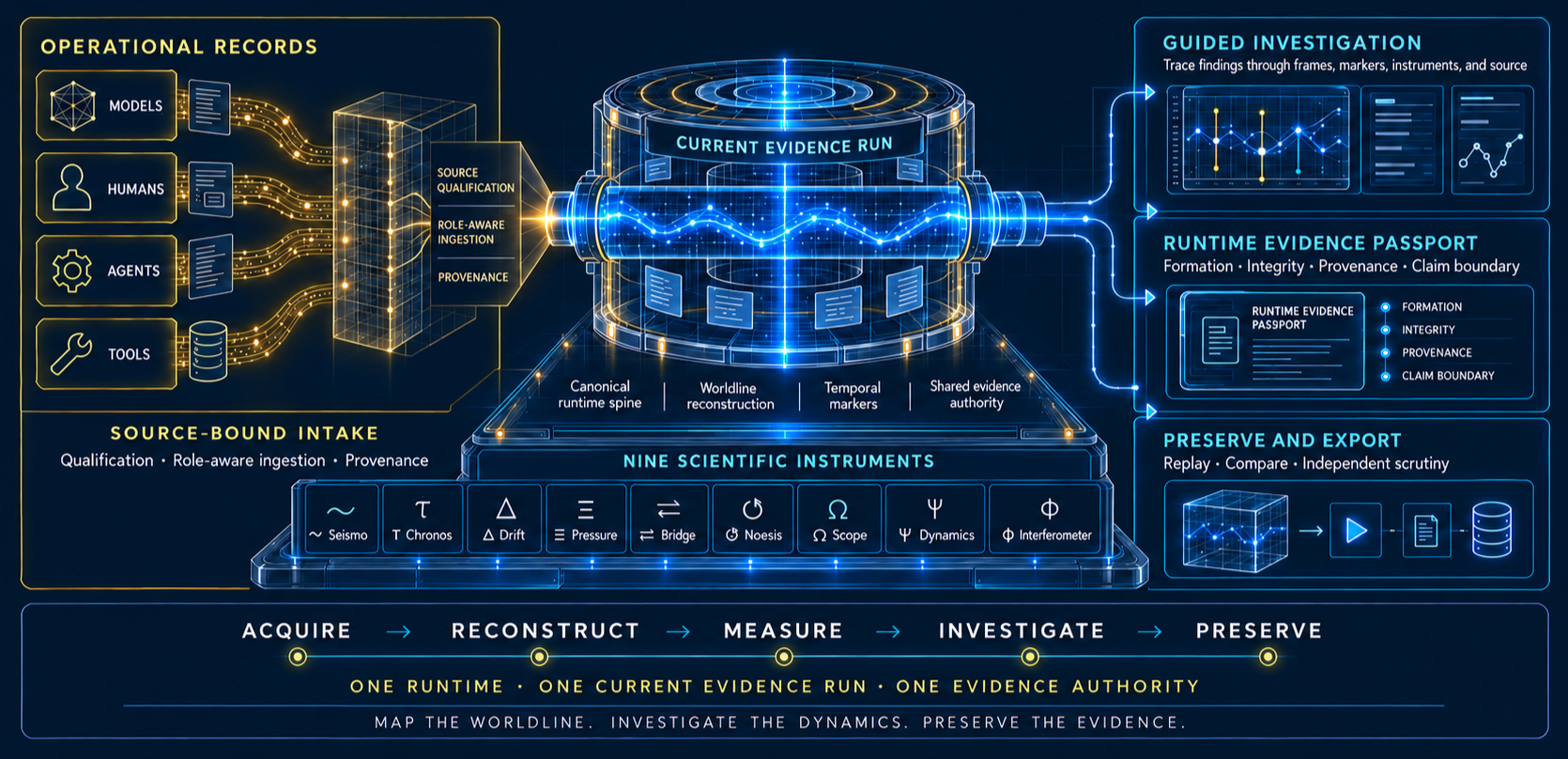
Within Aperture, operational records are qualified and transformed into a canonical runtime. Observable behavior is reconstructed as an ordered trajectory. Measurements, temporal markers, instrument findings, and interpretations remain bound to one authoritative Current Evidence Run.
Guided Investigation allows an operator to examine the trajectory, move between findings and source records, and contribute judgment without rewriting the underlying evidence. Adaptive interfaces may change how the investigation is presented, but they do not change what the evidence contains or authorizes.
The Runtime Evidence Passport preserves the identity, formation, integrity, availability, and claim boundaries of the resulting evidence record. Export and preservation carry that authority forward so subsequent investigators can inspect the reconstruction and evaluate what it supports.
Aperture does more than analyze operational records. It creates a traceable path from the record of computation to an inspectable reconstruction of longitudinal behavior—and from that reconstruction to the precise limits of what can responsibly be claimed.
-
A Unified Architecture for Runtime Evidence
One Evidence Authority Across the Entire System
The distinctive architectural contribution of SubstrateX is the unification of longitudinal behavioral reconstruction, temporal measurement, regime and role analysis, evidence authority, bounded claims, deterministic artifacts, and preservation within one externally inspectable computational system.
At its center is the Current Evidence Run: the source-bound evidence authority governing the active computation and investigation. It does not certify objective truth. It establishes which observations, transformations, measurements, findings, and interpretations are authorized by the available record—and where that authority ends.
Operational records are qualified and transformed into a canonical runtime from which worldlines, behavioral telemetry, regime classifications, role dynamics, temporal markers, instrument findings, and preservation artifacts are derived. Every projection remains connected to the same sources, provenance, runtime coordinates, computational methods, availability states, and explicit limits of interpretation.
The instruments may examine different dimensions of behavior, and the interfaces may adapt how those dimensions are presented, but neither can rewrite the underlying evidence or create authority merely by rendering a result.
This shared authority prevents separate instruments and surfaces from producing incompatible accounts of the same runtime. It allows a claim to be traced to its supporting finding, the finding to its method and coordinates, and those coordinates back to the originating record. Findings can therefore be inspected, challenged, reproduced under declared computational conditions, and preserved without separating conclusions from the evidence that supports them.
SubstrateX Aperture™ operationalizes this architecture as a complete Runtime Evidence Observatory. It brings source qualification, canonical runtime construction, deterministic behavioral telemetry, scientific instrumentation, guided investigation, evidence formation, replay, export, and preservation into one governed environment.
Under the same qualified sources, declared context, method versions, configuration, and processing conditions, Aperture produces the same computed evidence object and deterministic artifact.
This is the foundation of Evidence-Governed Computation™:
One source-bound runtime.
One Current Evidence Run.
Many bounded scientific projections.The result is more than runtime analysis. It is an architecture through which longitudinal computational behavior can become observable, measurable, reproducible, inspectable, challengeable, and accountable across time.
SubstrateX Aperture
Aperture™ is an early browser-local implementation of Runtime Evidence Infrastructure. It demonstrates source qualification, deterministic evidence formation, runtime reconstruction, bounded instrumentation,
Passport issuance, evidence sealing, and preservation. Its computational methods remain under controlled validation.
Runtime Evidence Observatory
SubstrateX Aperture™ is an integrated observatory for reconstructing, measuring, and investigating long-horizon computational behavior from observable operational records. Created by Arjay Asadi as the flagship system of SubstrateX®, it brings Longitudinal Computational Dynamics, Evidence-Governed Computation™, behavioral telemetry, scientific instrumentation, and guided investigation together within one browser-local environment.
Aperture transforms qualified logs, transcripts, traces, tool records, and workflow events into source-bound runtime reconstructions. These ordered, time-indexed trajectories—called worldlines—make continuity, displacement, pressure, role dynamics, boundary formation, regime transition, failure, and recovery available for measurement, replay, and investigation.
Aperture does not attempt to recover hidden model state. It reconstructs what the operational record permits an investigator to establish.
An Integrated Scientific Observatory
Aperture computes behavioral telemetry through a shared ingestion, reconstruction, and evidence-processing architecture. Nine scientific instruments then examine distinct dimensions of the same runtime:
∿ Seismo · τ Chronos · Δ Drift · Ξ Pressure · ⇄ Bridge · ⟳ Noesis · Ω Scope · Ψ Dynamics · Φ Interferometer
Each instrument reads from the same authoritative Current Evidence Run. None operates from an independent version of the runtime, and no instrument can create evidence authority merely by producing a result. The instruments provide bounded projections of temporal organization, trajectory displacement, recurrence, pressure, interaction dynamics, regime posture, boundary support, and recovery. Their measurements and findings remain connected to the same source records, runtime coordinates, computational methods, provenance, availability states, and claim boundaries.
The innovation is not any isolated metric or visualization. It is the complete architecture connecting operational records to measurable dynamics, scientific investigation, and preservation-ready Runtime Evidence.
From Operational Records to Investigable Worldlines
Aperture provides an end-to-end investigation environment spanning source qualification, role-aware ingestion, canonical runtime construction, behavioral telemetry, worldline formation, instrument inspection, forensic reconstruction, guided investigation, and evidence preservation.
Its role and interaction architecture supports recorded exchanges among models, humans, agents, tools, and workflows. Supported logs and trace formats can therefore be brought into a common analytical environment without requiring access to model weights, gradients, hidden states, training data, or proprietary model internals.
Investigators can move between the complete trajectory and its individual events, frames, roles, markers, measurements, and findings. They can examine how behavior developed, how participants influenced the runtime, when supported transitions became observable, and whether correction or recovery persisted.
Guided Investigation structures this process without replacing operator judgment. Operational World Mapping and adaptive presentation can change the language, emphasis, and investigative path presented to the operator, but they cannot alter the underlying evidence.
Evidence Governs the Entire System
Evidence-Governed Computation™ determines how observations become measurements, how measurements support findings, how instruments present those findings, and which claims the resulting record can legitimately support.
That discipline extends from ingestion through export. Signals, reconstructions, instrument views, interpretations, and preservation artifacts remain bound to one evidence authority. Missing information, unavailable measurements, uncertain interpretations, and analytical limits remain explicit.
The Runtime Evidence Passport identifies the resulting record and preserves its formation, integrity, availability, provenance, and claim boundaries. Export and preservation carry this context forward so that subsequent investigators can inspect the reconstruction, challenge its findings, and assess its reproducibility under the declared processing conditions.
SubstrateX Aperture™ brings intelligence in motion into one governed environment for measurement, reconstruction, investigation, replay, and accountability.
Reconstruct the runtime.
Investigate the trajectory.
Preserve the evidence.
From Investigation to Evidence Artifact
An Aperture™ investigation culminates in a structured evidence artifact that connects the reconstructed runtime to its source records, instrument findings, provenance, and explicit claim boundaries. The Runtime Evidence Passport identifies the evidence record and makes its formation, integrity, and permitted scope of interpretation inspectable. It documents what was established through the available record and processing methods; it does not confer authority beyond them.
Preservation and export carry this context forward, allowing subsequent reviewers to examine the reconstruction, trace supported findings, and assess reproducibility under the recorded processing conditions.
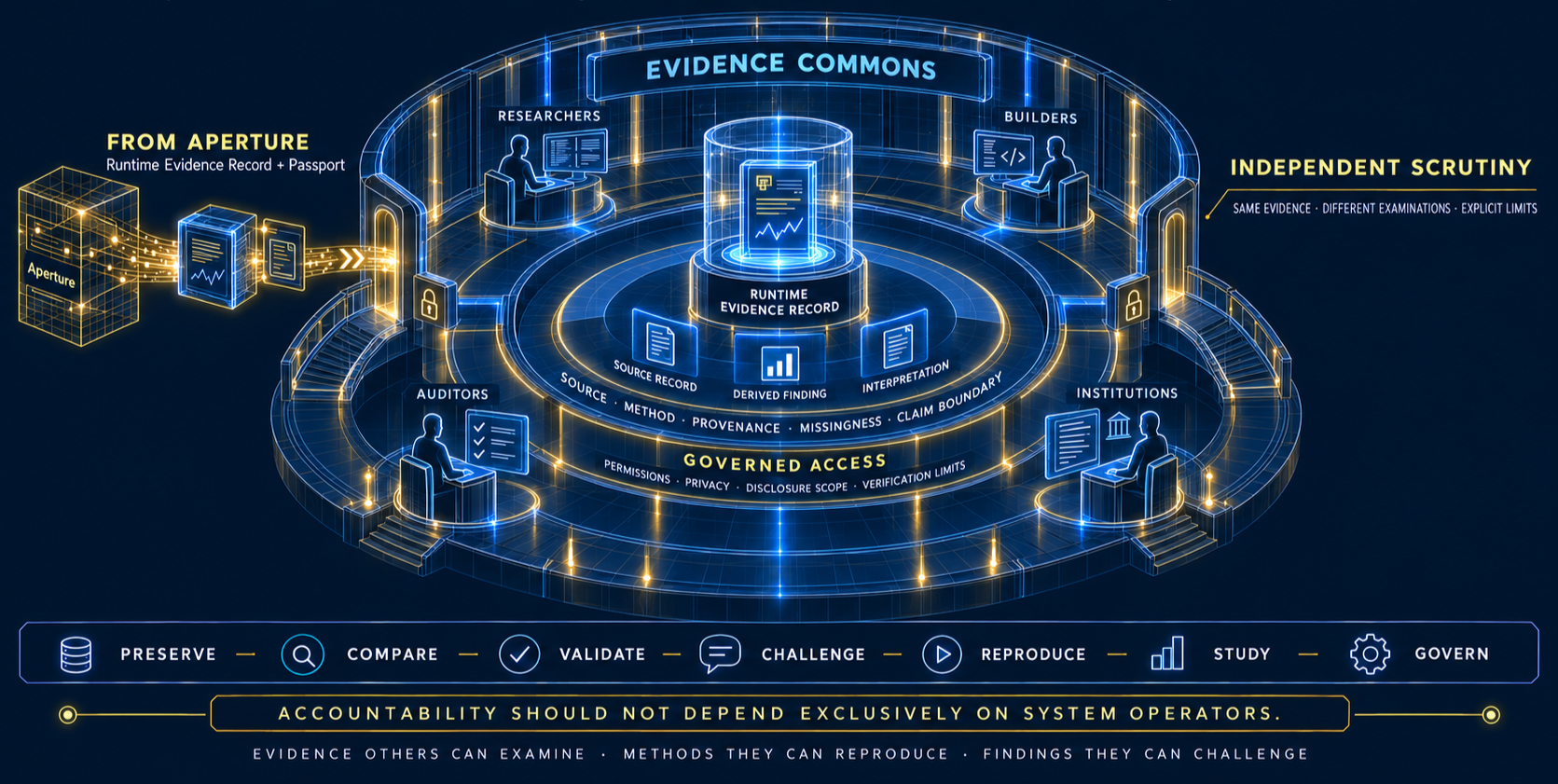
The investigation produces more than a view of runtime behavior. It produces an evidence record designed to remain examinable beyond the session in which it was formed. That is the connection to Evidence Commons: evidence generated within an instrument becomes available for preservation, exchange, comparison, and independent scrutiny.
Evidence Commons
From Runtime Evidence to Civic Accountability
SubstrateX Aperture™ makes Runtime Evidence operational. Evidence Commons defines how that evidence can remain inspectable beyond a single investigation, instrument, organization, or platform.
Evidence Commons is a shared framework for the preservation, comparison, exchange, and governance of Runtime Evidence. Its purpose is to help evidence artifacts move across institutional and technical boundaries while retaining their provenance, formation history, reproducibility conditions, availability state, and explicit claim boundaries.
Its premise is straightforward:
Accountability for intelligent systems should not depend exclusively on the organizations that build, operate, or monitor them.
Independent scrutiny requires evidence that qualified parties can examine, methods they can reproduce, and findings they can challenge. It also requires explicit terms for access and disclosure so that sensitive operational records can remain protected while authorized review, verification, and comparison become possible.
A commons of evidence does not mean that every source record must become public. It means that access conditions, disclosure boundaries, redactions, verification limits, and permitted uses remain visible and governable rather than being separated from the evidence itself.
A Commons of Evidence
Evidence Commons establishes a framework through which Runtime Evidence can be:
Preserved · Compared · Examined · Challenged · Reproduced · Studied · Governed
Shared structures allow researchers, builders, auditors, regulators, institutions, and affected communities to examine evidence across contexts while preserving the distinctions among original source records, transformed observations, computed measurements, derived findings, and human interpretation.
Evidence may be public, restricted, redacted, or available only to authorized reviewers. In every case, the conditions governing access and verification must remain explicit. A finding should never appear more independently established than the evidence made available for examining it.
The objective is a durable evidentiary layer for intelligent systems—one in which findings remain connected to their sources and methods, disagreements can become structured investigations, and accountability can be supported by reproducible evidence rather than unsupported explanation.
Longitudinal Computational Dynamics establishes what is studied.
Evidence-Governed Computation™ constrains what may be claimed.
Runtime Evidence binds reconstruction to sources, methods, and bounded findings.
SubstrateX Aperture™ makes that evidence operational.
Evidence Commons carries it into preservation, comparison, and independent scrutiny.