

⚙️ SubstrateX Aperture™ Runtime Evidence Observatory
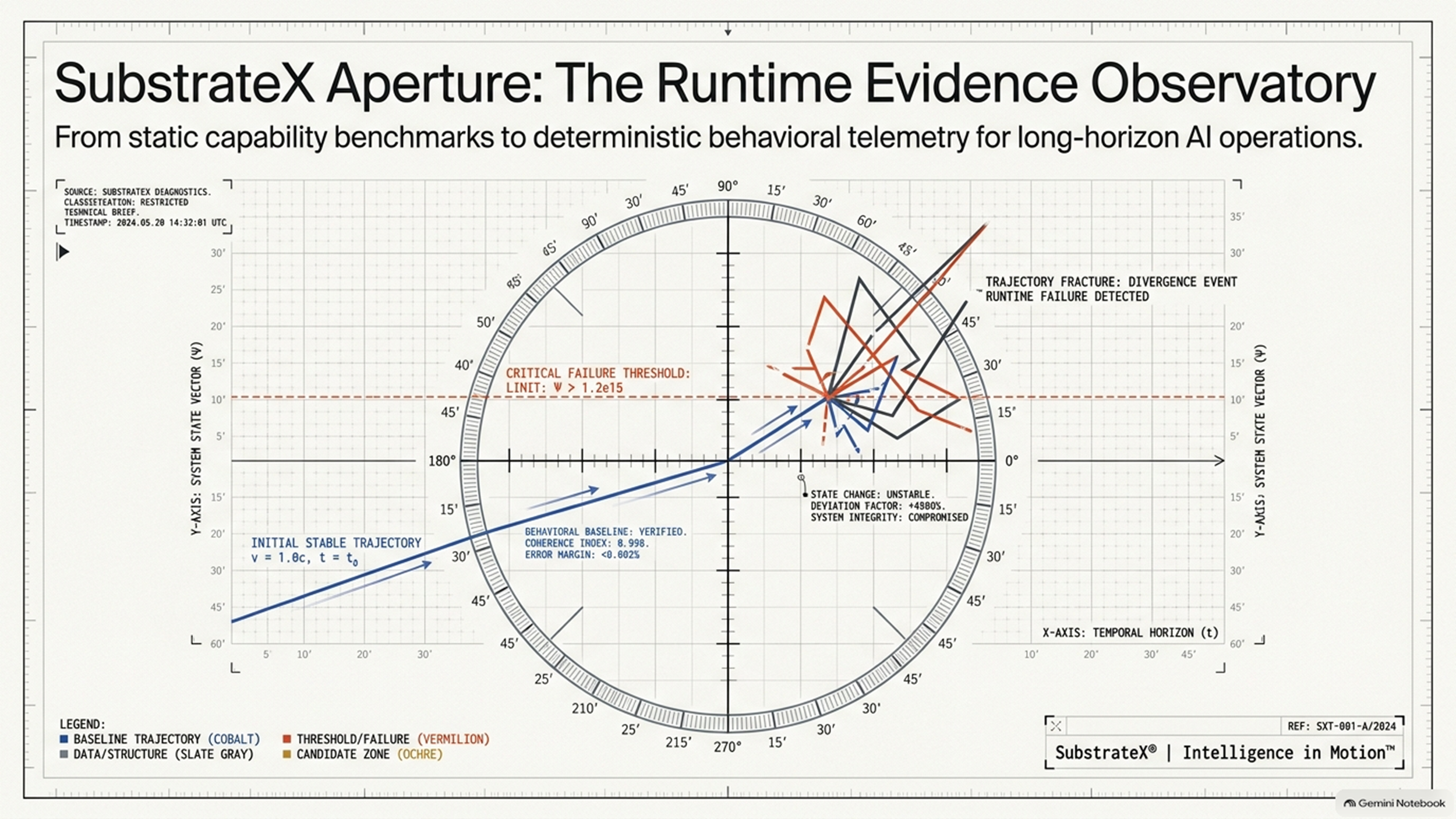
Aperture™ is the flagship system of SubstrateX® and the principal operational expression of its Runtime Evidence Infrastructure for long-horizon AI.
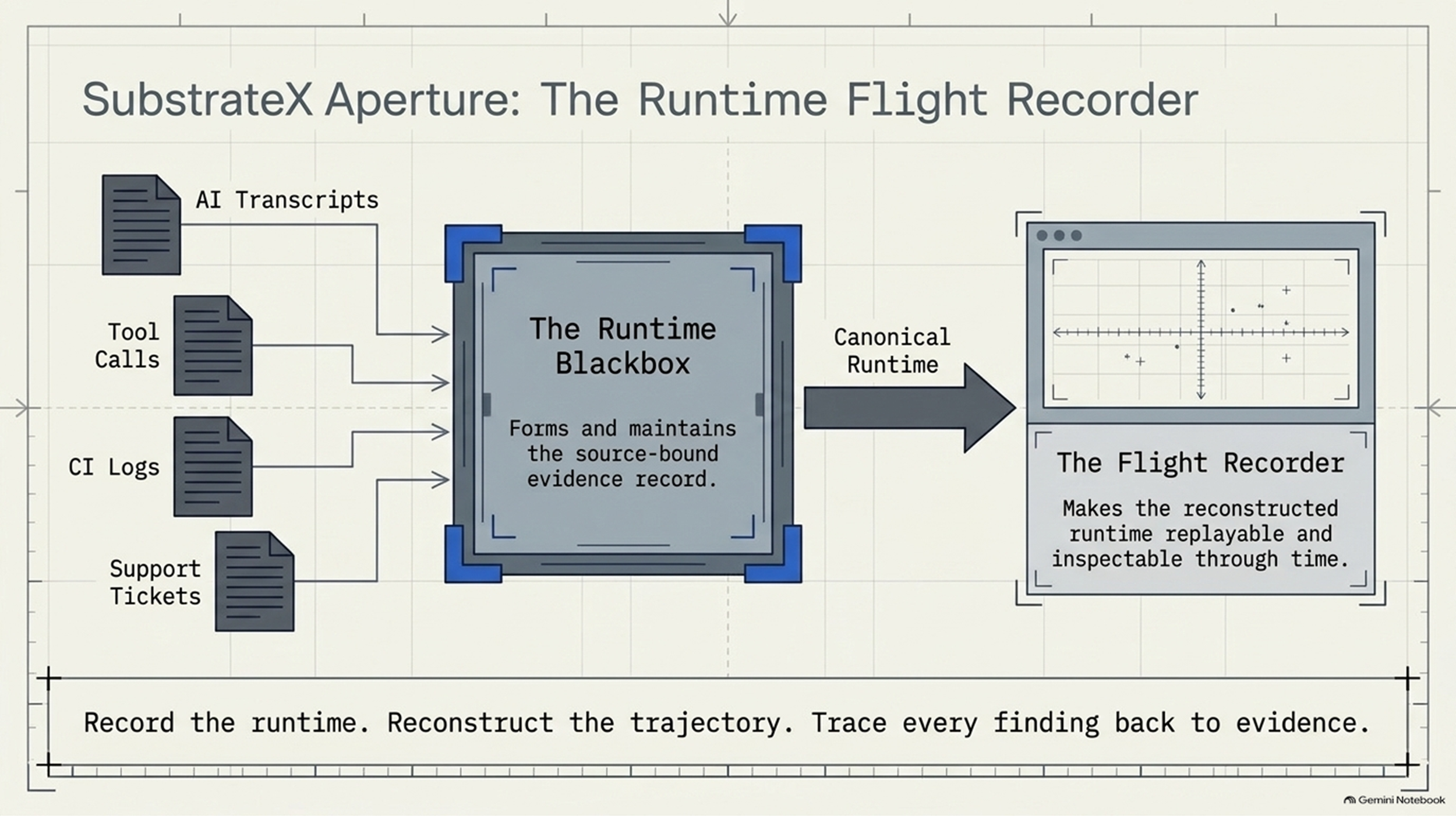
Aperture is a browser-local Runtime Evidence Observatory for reconstructing, measuring, and investigating how computational behavior develops across time. It transforms qualified logs, traces, transcripts, tool events, incident records, tickets, and workflow artifacts into source-bound runtime reconstructions that can be inspected, replayed, challenged, compared, exported, and preserved.
The system is organized around a precise engineering objective:
Reconstruct Longitudinal Computational Behavior from observable operational records while keeping every measurement, finding, interpretation, interface, and export subordinate to one evidence authority.
Aperture is not simply a dashboard, monitoring layer, trace viewer, or collection of analytical panels. It is an integrated observatory in which runtime reconstruction, behavioral telemetry, scientific instrumentation, Guided Investigation, provenance, claim governance, and evidence preservation operate as one inspectable system.
Its significance does not depend on asserting the existence of a new field. It depends on whether the system can do the work:
reconstruct a runtime deterministically under declared inputs and methods;
preserve source identity and transformation lineage;
represent roles, events, dependencies, and temporal coordinates without flattening them;
compute registered behavioral telemetry from eligible evidence;
maintain one authoritative Current Evidence Run across every instrument and interface;
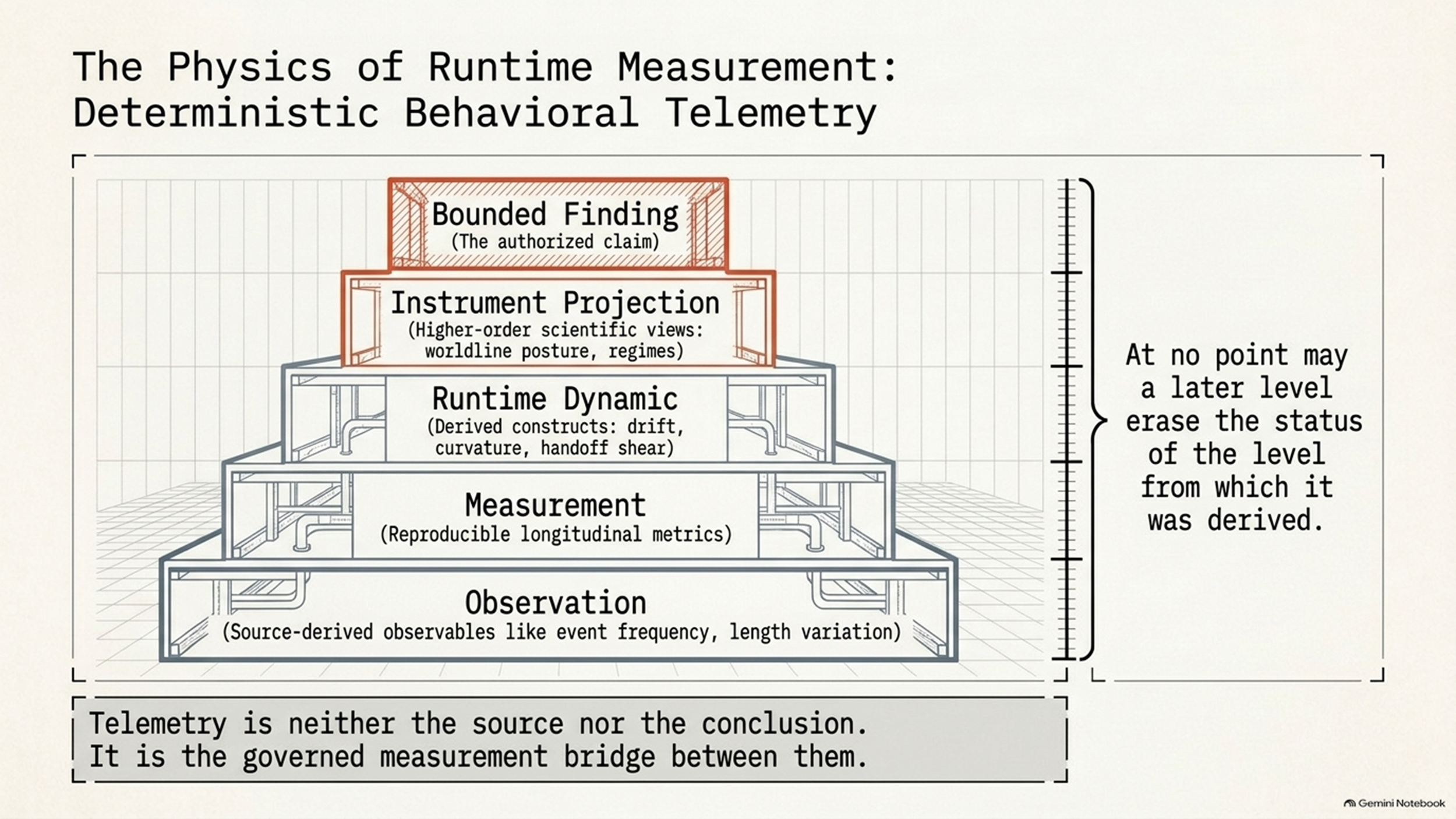
distinguish observations, measurements, findings, interpretations, and claims;
expose missingness, uncertainty, conflict, and non-computable states;
preserve explicit claim boundaries; and
produce Runtime Evidence that remains examinable beyond the original investigation.
That is the engineering proposition Aperture makes operational.
Why Aperture Exists
Long-horizon computational systems produce extensive operational records while remaining difficult to investigate as developing behavioral processes.
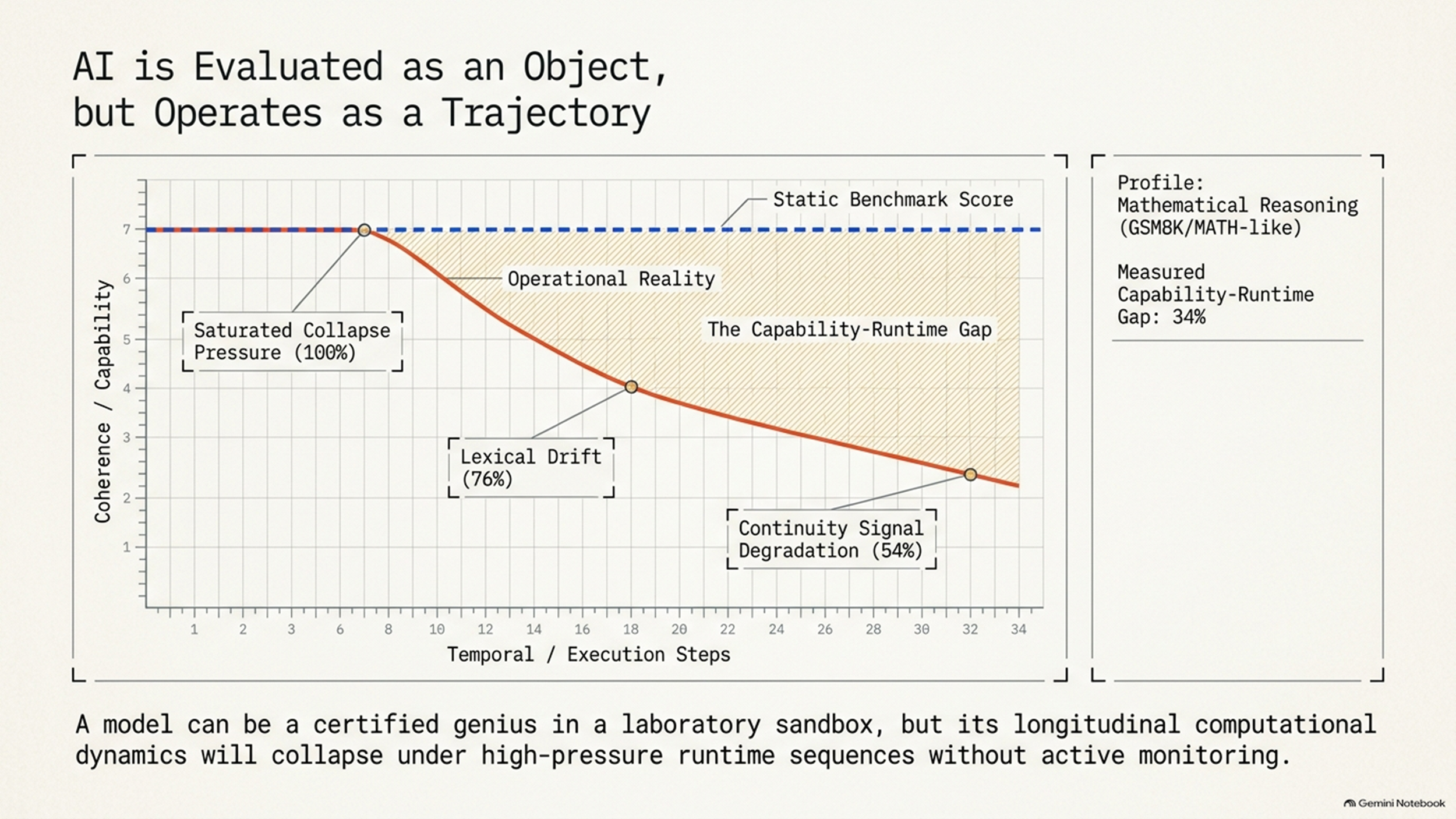
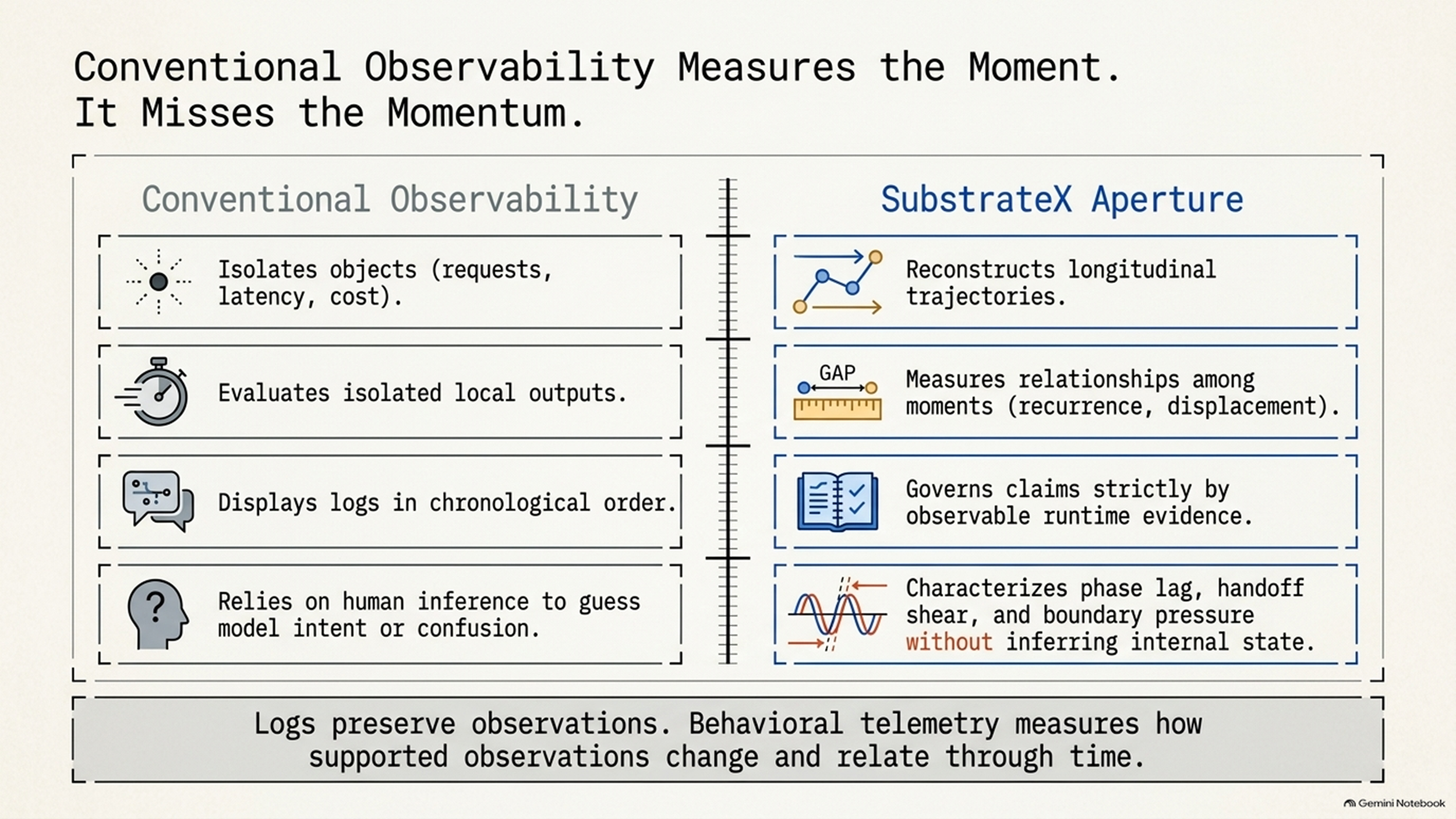
A log can establish that an event was recorded. A distributed trace can connect spans. A monitoring platform can report latency, availability, throughput, cost, and errors. A benchmark can evaluate a selected capability or outcome.
These systems do not necessarily reveal:
how the runtime developed as an ordered trajectory;
whether earlier objectives and constraints remained active;
how models, people, agents, tools, and workflows affected what followed;
where displacement, contradiction, recurrence, or coordination pressure accumulated;
whether a perturbation was absorbed or propagated;
whether a correction altered subsequent behavior;
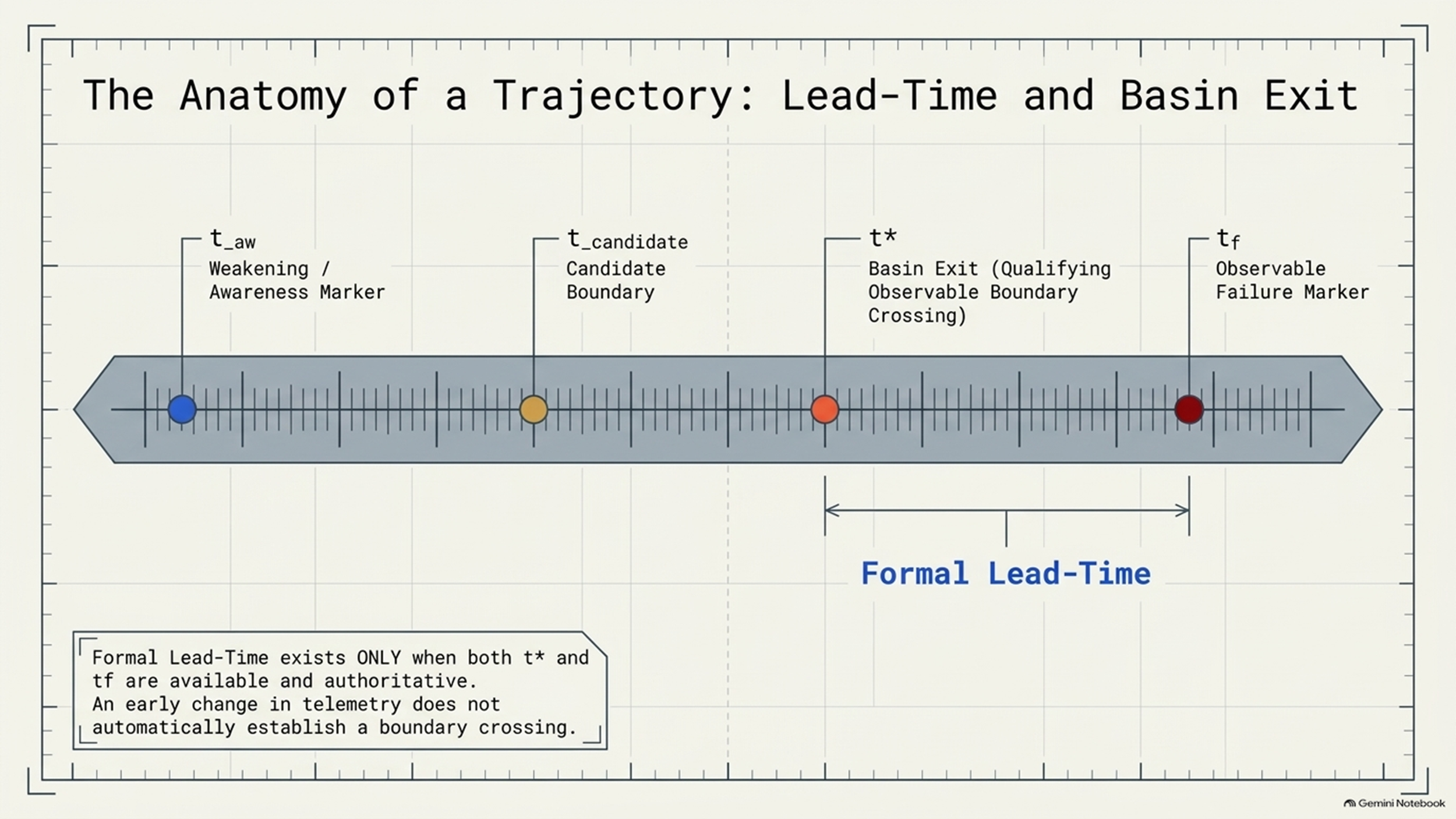
when a qualifying transition became supportable;
whether recovery persisted;
which findings were available prospectively and which appeared only in retrospect; or
what the available evidence legitimately permits an investigator to conclude.
Aperture begins from a different unit of analysis.
The individual event remains important, but the primary empirical object is Longitudinal Computational Behavior: the ordered development of observable computational activity across a bounded runtime.
Prior activity may re-enter through context, records, tools, roles, memory, orchestration, workflow state, human intervention, and environmental consequence. The resulting runtime may exhibit continuity, displacement, recurrence, transition, Collapse, Recovery, or unresolved continuation.
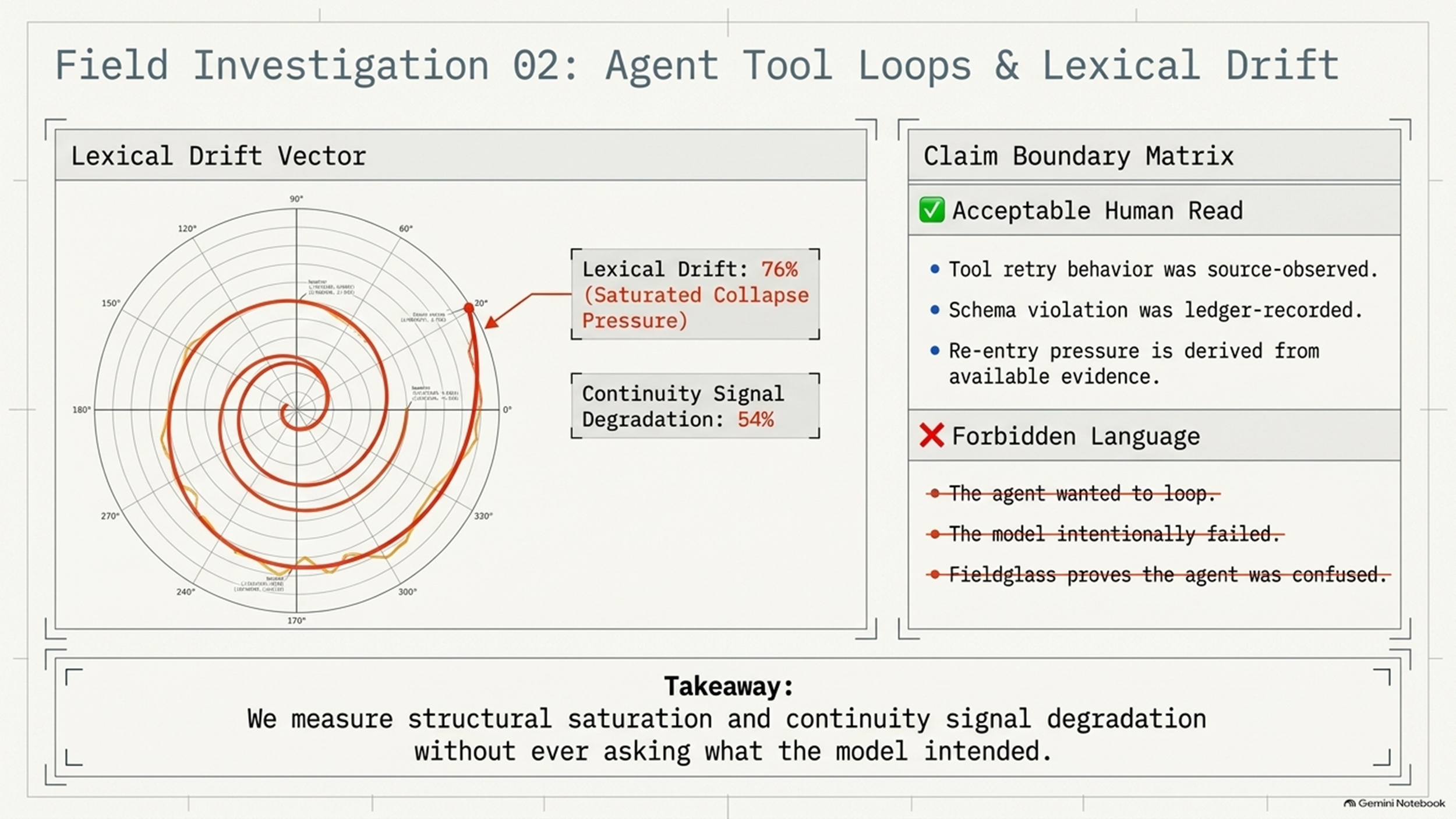
The operational record does not expose a hidden mind or reproduce the system’s complete internal state. It preserves observable traces of behavior in motion.
Aperture reconstructs the strongest evidence-bound account those traces can support.
The Engineering Foundations
Aperture brings several layers of the SubstrateX program into one working system.
Intelligence in Motion™ supplies the organizing proposition: intelligence is expressed not only through stored capability, but through behavioral organization developing across time.
Longitudinal Computational Dynamics® supplies the scientific framework for investigating state, trajectory, temporal organization, stability, recurrence, transition, failure, and recovery.
Longitudinal Computational Behavior supplies the primary empirical object.
Computational Behavior Architecture supplies the representational objects required to reconstruct the runtime: sources, events, frames, roles, dependencies, temporal coordinates, states, worldlines, regimes, markers, measurements, and findings.
Evidence-Governed Computation™ supplies the governing architecture. It constrains every authoritative computation and claim to eligible evidence, declared methods, explicit status, and bounded scope.
Runtime Evidence is the resulting source-bound evidentiary output: the reconstructable record of what was supplied, how it was transformed, what was measured, which findings were supported, and where the evidence requires interpretation to stop.
The Evidence Architecture Framework supplies implementation contracts for provenance, identity, availability, lineage, method versioning, claim authority, replay, export, and preservation.
Aperture integrates these foundations without collapsing their functions. The science defines what may be investigated. The architecture defines how the runtime is represented and governed. The system makes the complete relationship executable and open to testing.
From Operational Records to Runtime Evidence
Aperture organizes the evidence lifecycle through one authority path:
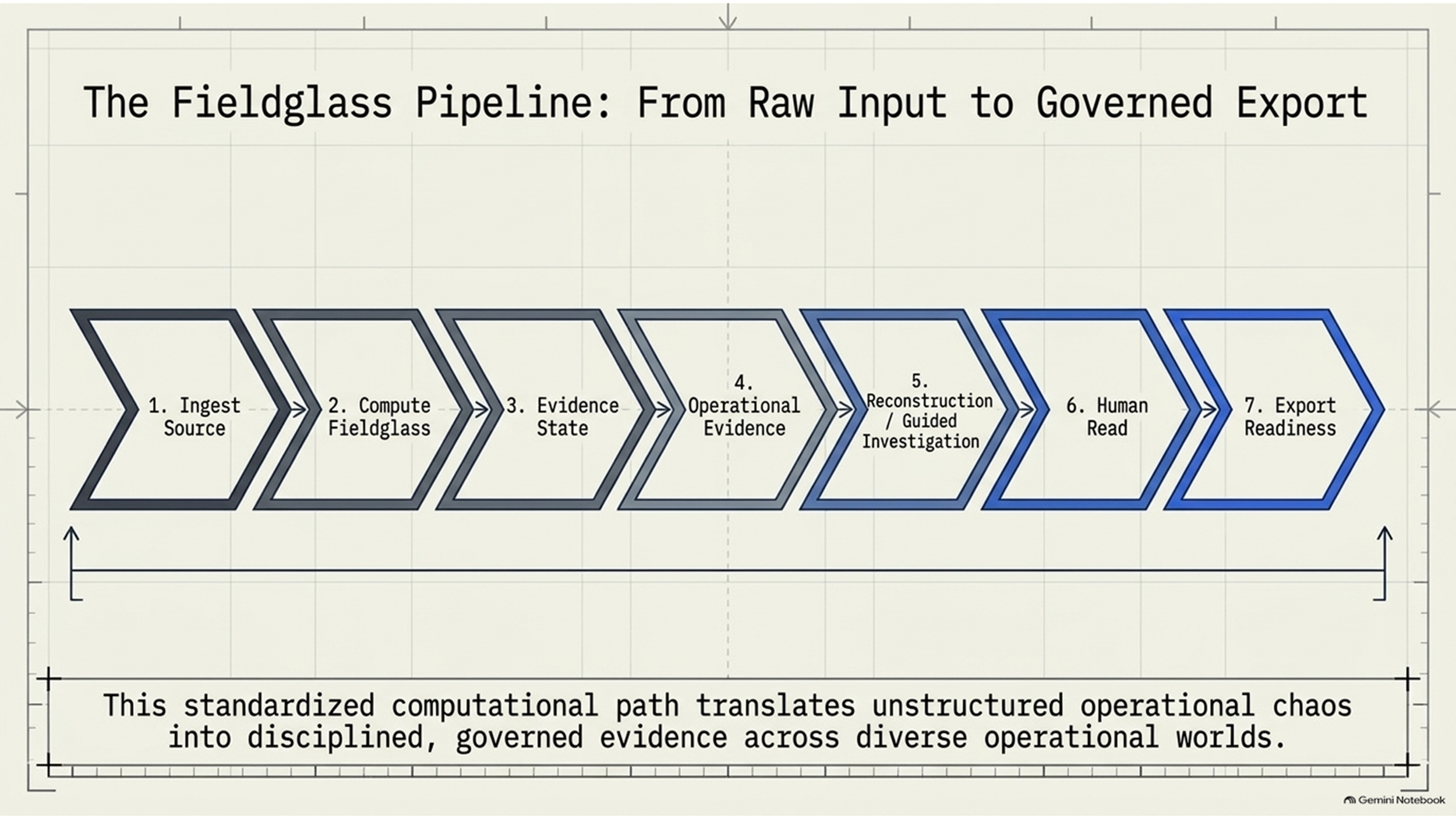
Source records → Qualification → Canonical runtime → Current Evidence Run → Behavioral telemetry → Bounded instrument projections → Guided Investigation → Certified Runtime Evidence Record → Runtime Evidence Passport → Preservation
Each stage has a distinct responsibility.
Source records
The source layer preserves the material supplied to the investigation together with its origin, format, identifiers, ordering information, and disclosure state.
Qualification
Qualification determines what the supplied material can support. It records coverage, missingness, temporal quality, role information, source limitations, integrity information, and computations that are unavailable or inappropriate for the case.
Qualification does not certify that the source is complete, authentic, or true. It establishes the conditions under which the source may enter the reconstruction.
Canonical runtime
Canonicalization transforms heterogeneous records into a consistent event and frame structure without erasing their source identity. Original positions, normalized roles, temporal coordinates, dependencies, source spans, and transformation history remain traceable.
Current Evidence Run
The Current Evidence Run is the authoritative computational object for the active investigation. It binds the canonical runtime, runtime spine, playback frames, measurements, markers, regime history, instrument models, findings, availability states, and evidence record to one run identity.
Behavioral telemetry
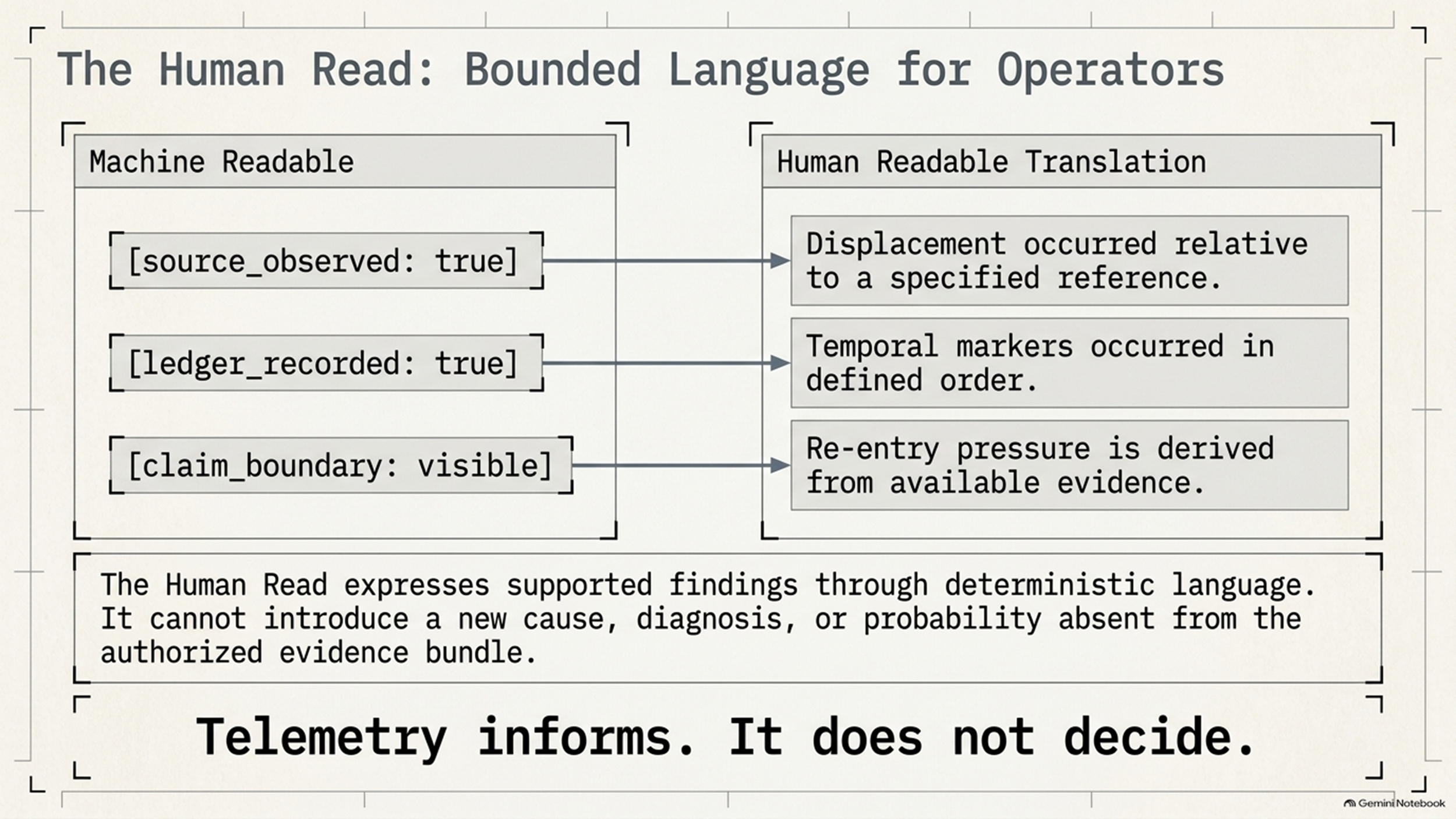
Registered measurements are computed from eligible evidence under declared contracts. Their dependencies, method versions, temporal horizons, status, uncertainty, and claim boundaries remain explicit.
Bounded instrument projections
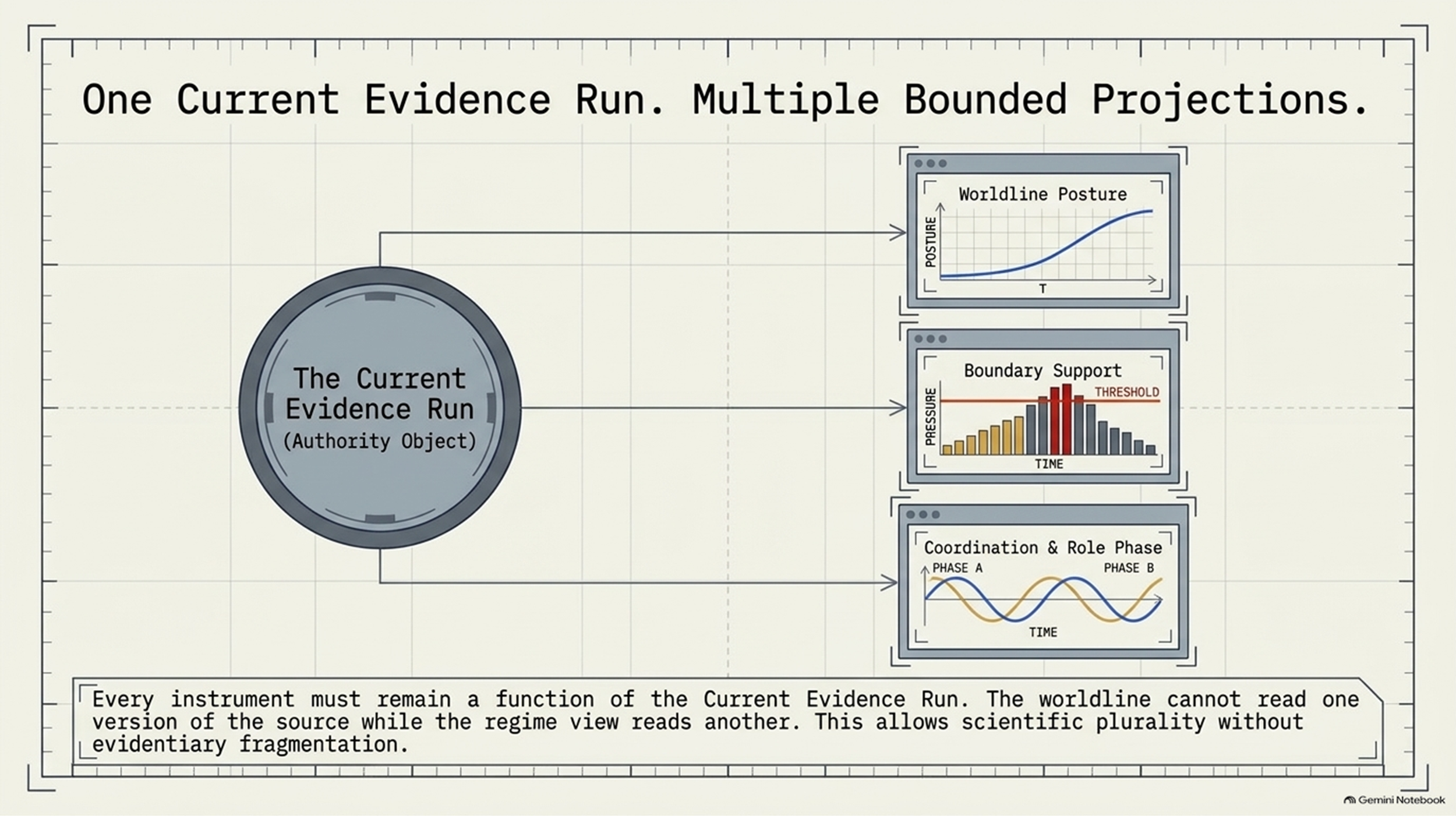
Instruments examine different dimensions of the same Current Evidence Run. They may organize and transform authorized measurements, but they do not create independent source facts, competing marker histories, or separate evidentiary realities.
Guided Investigation
Investigators move through source-linked questions, findings, frames, measurements, and alternative interpretations without rewriting the evidence beneath them.
Certified Runtime Evidence Record
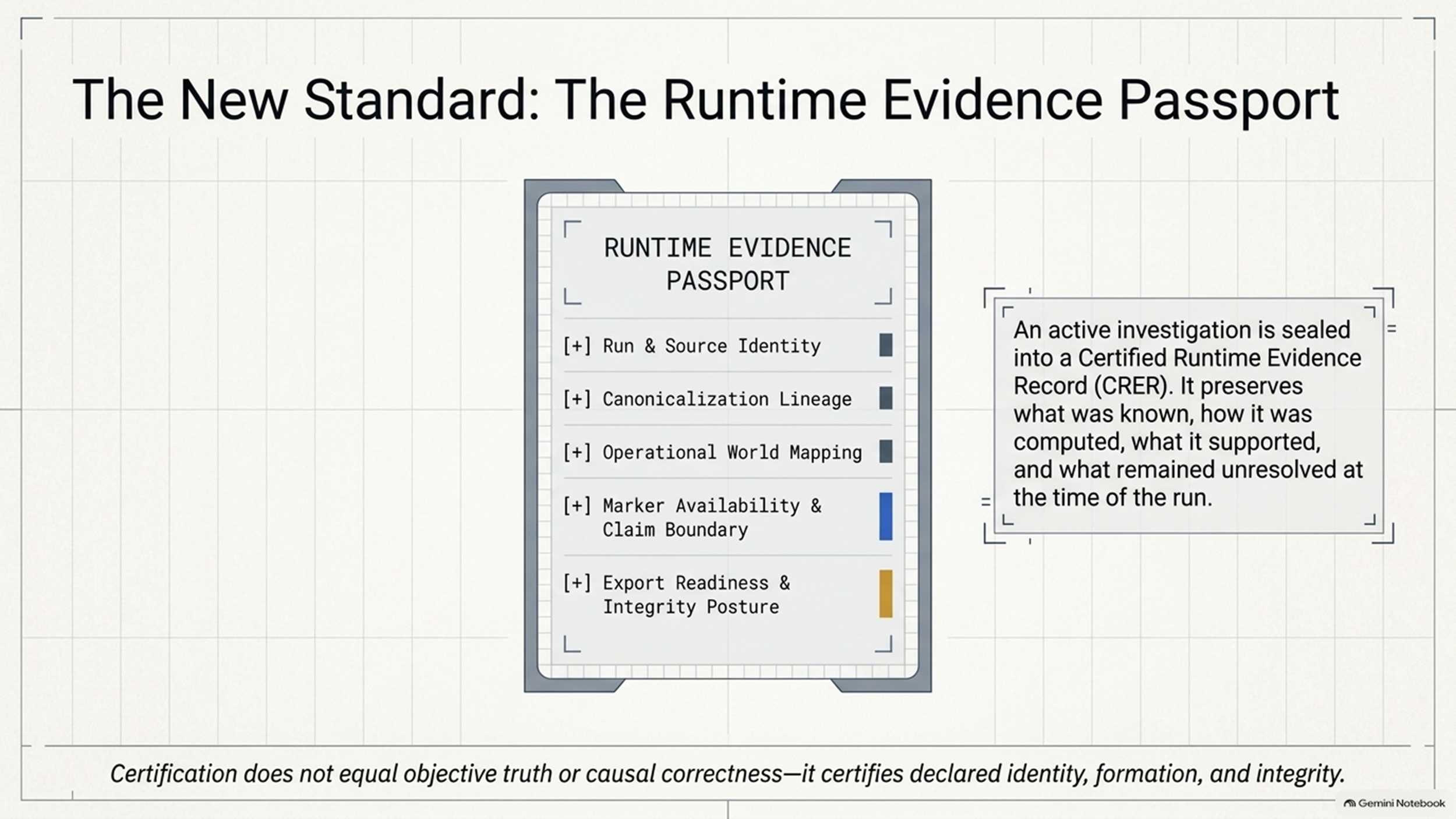
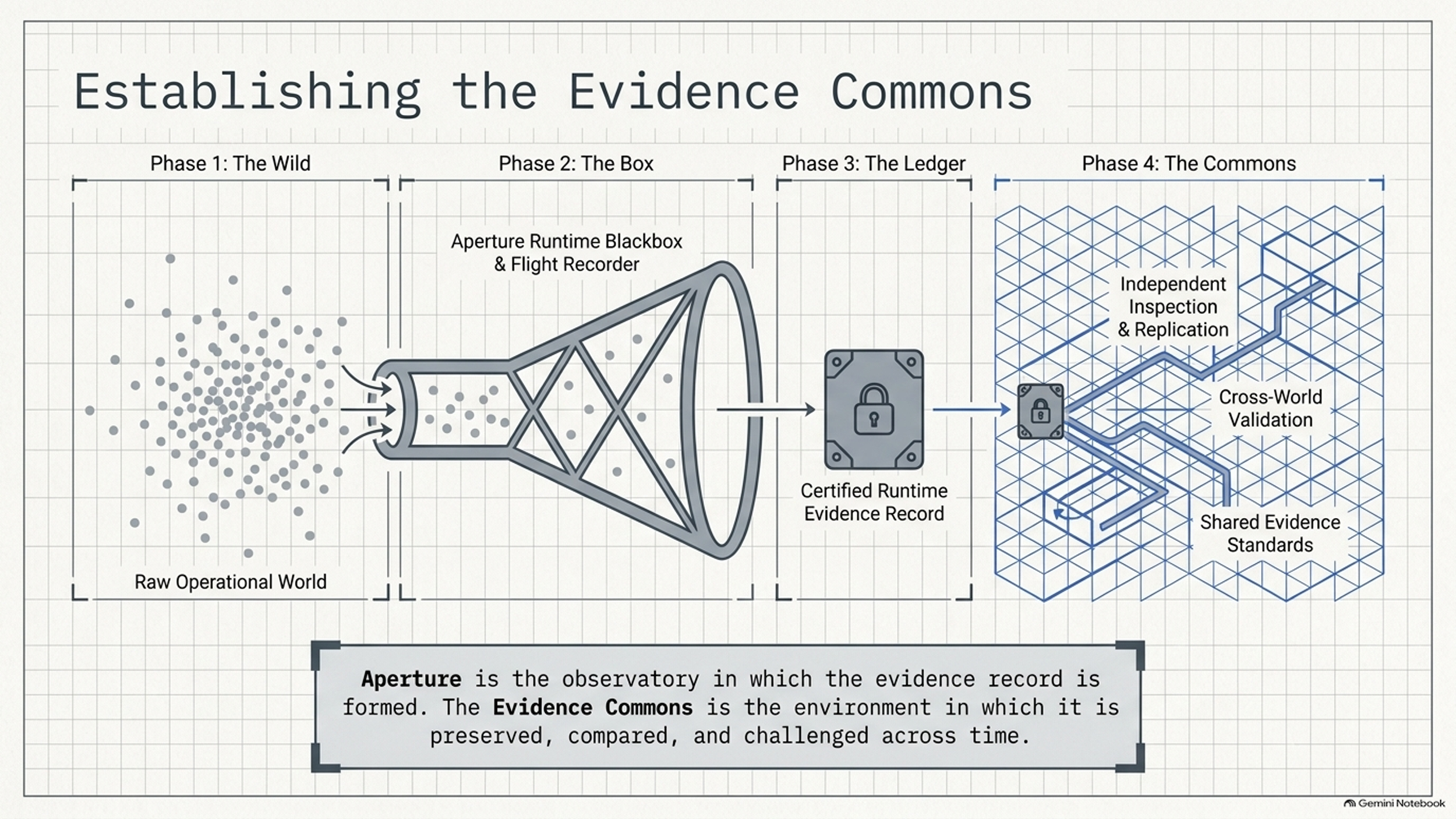
When the declared issuance requirements are satisfied, the eligible contents of the Current Evidence Run are sealed as a Certified Runtime Evidence Record (CER). The CER is the source-bound, versioned evidence artifact carried forward from the active investigation. It preserves the canonical runtime, methods, measurements, findings, missingness, provenance, review state, replay conditions, and claim boundaries established under the applicable contract.
Certification has a deliberately bounded meaning. It establishes that the record completed the declared formation, identity, integrity, provenance, conformance, and preservation requirements. It does not certify that the supplied source is complete or authentic, that every measurement is scientifically valid, that an interpretation is causally correct, or that the investigated system is safe.
Runtime Evidence Passport and preservation
The Passport identifies the resulting Certified Runtime Evidence Record and preserves its formation, integrity, availability, method versions, disclosure conditions, and claim limits. Preservation carries the CER and that context beyond the active interface. Authority may be preserved or narrowed as information moves through this sequence. It cannot be increased merely because a result appears in an instrument, narrative, brief, visualization, or export.
One Runtime, One Continuous Evidence Authority
Aperture is governed by one central design commitment:
One runtime. One active Current Evidence Run. One issued Certified Runtime Evidence Record. One continuous evidence authority. Multiple bounded instruments.
Complex analytical systems often allow individual panels, instruments, reports, or exports to compute their own versions of the case. Over time, thresholds diverge, labels drift, markers move, and summaries become detached from the evidence that originally supported them.
Aperture prevents this by making the Current Evidence Run the shared computational authority during investigation. Certification seals the eligible evidence as the CER without creating a competing history or increasing the authority of the underlying evidence.
A worldline, regime panel, role map, scientific instrument, investigation chapter, operator brief, replay surface, Passport, and export may present different dimensions of the runtime. None may independently redefine its canonical facts.
If a qualifying Basin Exit is registered at a particular frame, every authoritative surface must resolve to the same marker identity, method, status, and source support. If an instrument presents a secondary threshold, experimental model, or method-specific alternative, the difference must remain explicit, versioned, and subordinate to the canonical evidence.
Multiple perspectives are permitted.
Multiple evidence authorities are not.
Three Ways to Enter the Observatory
The public Aperture implementation provides three distinct intake paths.
Guided Samples
Guided Samples introduce operators to the evidence lifecycle through compact reference runtimes drawn from different Operational Worlds.
They demonstrate how an operational record becomes a canonical runtime, Current Evidence Run, worldline, instrument projection, investigation, Certified Runtime Evidence Record, Passport, and preservation artifact.
Curated, synthetic, illustrative, or partially disclosed content remains identified as such. Sample metadata is not permitted to alter the instrumentation or predetermine the finding.
External Source Intake
Operators can paste or upload logs, traces, transcripts, tickets, tool records, incident material, workflow artifacts, and related operational evidence.
Aperture does not presume an expected result. It qualifies the supplied material, identifies unsupported or missing elements, and determines which reconstruction and measurement contracts can operate on the available record.
Validation Lab
The Validation Lab contains registered cases with declared purposes, source conditions, expected observable relationships, intentionally supplied or withheld evidence, and conformance criteria.
These cases test whether the implementation behaves as specified. Expected results belong to the fixture and validation manifest. They do not become hidden answers supplied to instruments or injected into the Current Evidence Run. The three intake paths serve different purposes—learning, external investigation, and implementation validation—but converge on the same canonical reconstruction and evidence-governance architecture.
Source Qualification and Canonical Ingestion
The strength of a reconstruction depends on the source entering it.
Aperture therefore separates ingestion from qualification. Successful parsing does not mean that a record is sufficient for every analysis.
The intake process may examine:
file and source identity;
source type and schema;
event and turn coverage;
timestamp quality;
actor and role disclosure;
tool and workflow representation;
model and configuration disclosure;
outcome and marker availability;
missing or conflicting fields;
preprocessing and adapter history;
integrity information;
and constraints on independent verification.
The resulting canonical event ledger preserves what was supplied, how each observation was normalized, and where the reconstruction contains uncertainty.
Missing evidence remains missing. An unavailable measurement does not become zero. An unknown role does not become a guessed identity. An absent failure marker does not become proof that no failure occurred.
Role-Aware Runtime Reconstruction
Long-horizon computational behavior often belongs to an interaction rather than to one model.
Humans, assistants, agents, tools, services, managers, engineers, observers, administrators, orchestrators, and system instructions can each alter the trajectory. Flattening these participants into one undifferentiated stream removes evidence needed to investigate authority changes, handoffs, contradictions, delays, tool loops, and recovery.
Aperture therefore treats role and interaction topology as first-class computational structures.
The reconstruction can preserve:
participant and system identifiers;
original and normalized role labels;
the source and confidence of role assignments;
operational authority and responsibility boundaries;
unresolved or competing assignments;
role transitions and handoffs;
objective and constraint ownership;
cross-role displacement;
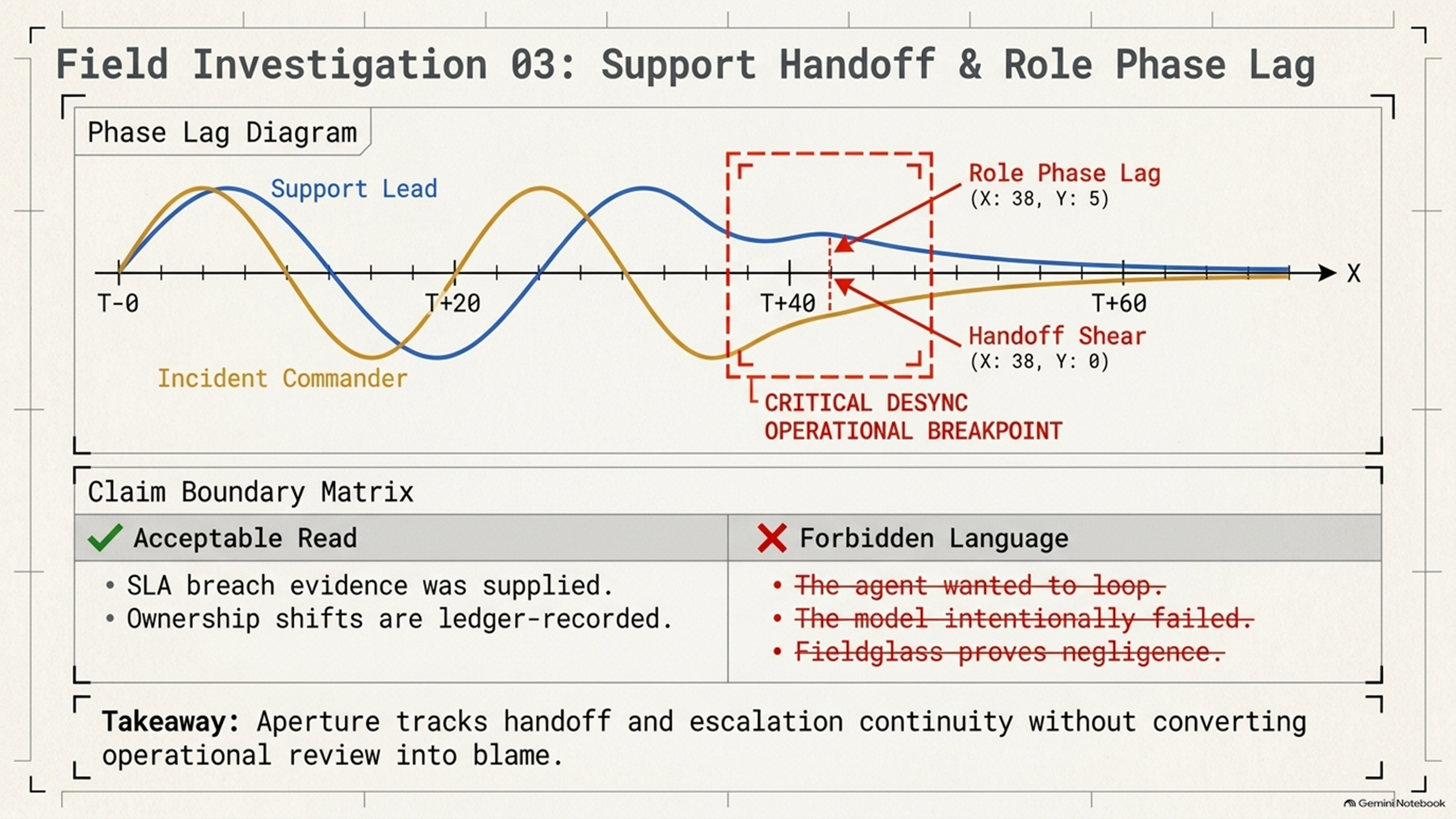
role-relative lag and temporal shear;
tool-loop state;
observer-state divergence; and
whether correction or new information propagated across participants.
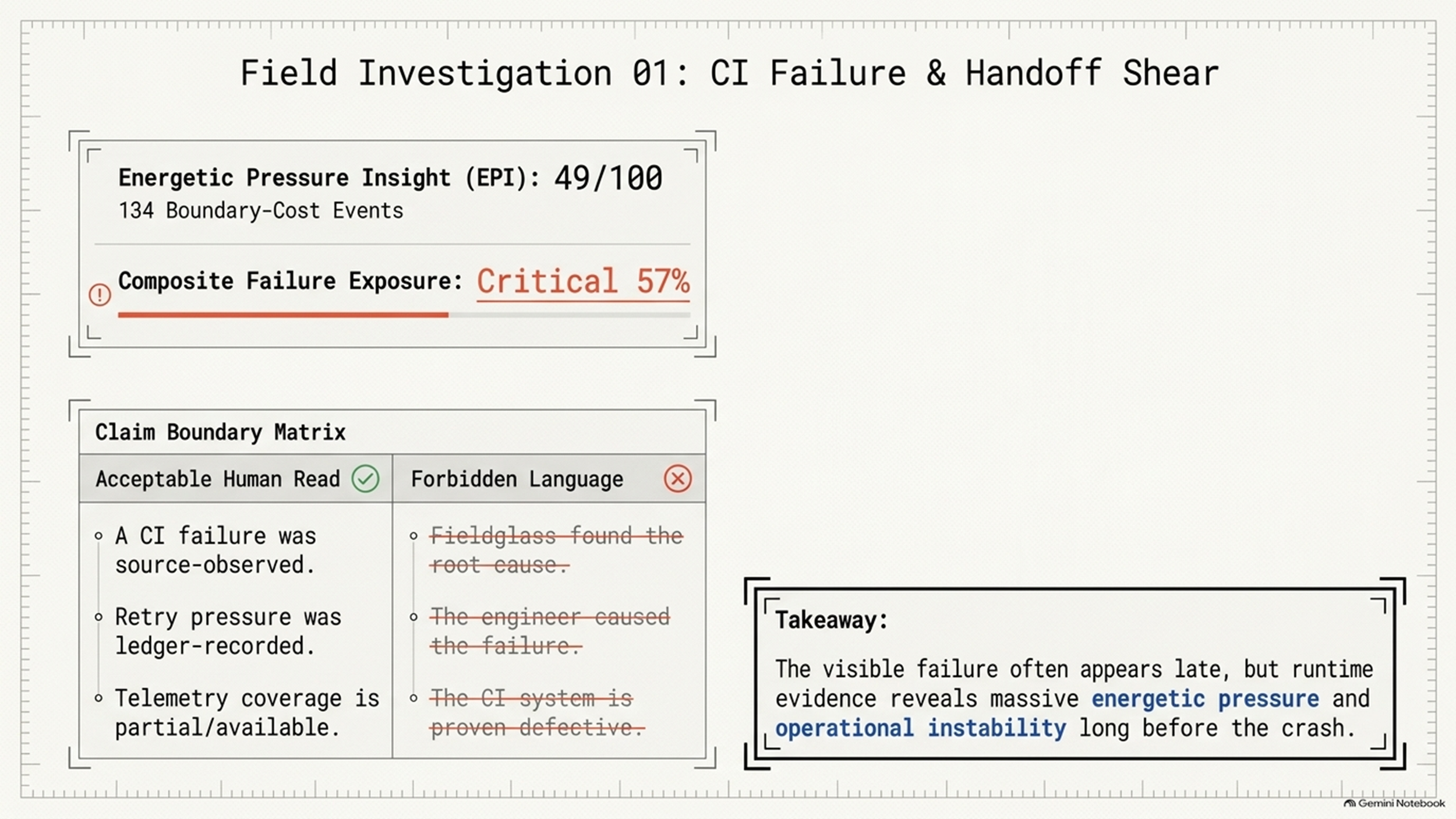
These structures describe operational relationships supported by the record. They do not establish private intent, psychological identity, fault, legal responsibility, or organizational truth.
Role awareness makes it possible to ask not merely who acted next, but whether the evidence, objective, constraints, authority, and state required for coherent continuation survived the transition.
The Canonical Runtime Spine
After qualification and canonicalization, Aperture organizes the record into a runtime spine and a sequence of evidence-bearing frames.
Each frame may contain:
the source observations incorporated at that position;
canonical events and source links;
active actors, roles, and role relations;
source, clock, turn, event, dependency, frame, and symbolic-time coordinates;
registered behavioral measurements;
regime and marker states;
evidence-support and availability states;
applicable uncertainty and conflict;
prospective or retrospective status;
and the methods and versions responsible for every derived object.
Together, these frames support an evidence-bearing worldline: the ordered projection of behavioral development reconstructed from the observable record.
The worldline is not the system’s hidden internal trajectory. It is an externally inspectable representation constructed under declared methods and limited by the evidence available.
This structure makes the runtime navigable. An operator can move from the complete trajectory to a regime interval, from the interval to a frame, from the frame to a measurement, and from the measurement back to the event and source span on which it depends.
Shared Behavioral Telemetry
Aperture computes registered behavioral telemetry once within the authority of the Current Evidence Run.
The shared telemetry layer may represent supported properties involving:
runtime continuity and displacement;
recurrence and operational re-entry;
reference-relative drift;
contradiction and pressure proxies;
temporal density, lag, shear, and coupling;
role and handoff dynamics;
containment and boundary support;
regime development;
candidate and confirmed transitions;
observable outcome relationships;
re-entry, relapse, and recovery support;
evidence coverage, integrity, and availability; and
source-to-finding lineage.
These measurements are not free-floating metrics. Each requires a registered measurand, source dependency, computation or derivation path, temporal coordinate, method version, status, and claim boundary.
The shared telemetry layer prevents every instrument from calculating a private version of the runtime. Instrument-specific transformations remain possible, but their distinction from canonical telemetry must remain explicit.
The telemetry is shared. The instruments are plural. The evidence authority remains singular.
Nine Bounded Scientific Instruments
SubstrateX Aperture projects the reconstructed runtime through nine bounded scientific instruments:
∿ Seismo examines worldline formation, disturbance, transition, boundary support, observable failure, and recovery.
τ Chronos examines temporal coordinates, symbolic progression, density, compression, dilation, recurrence, lag, shear, locking, and marker relationships.
Δ Drift examines reference-relative displacement from registered objectives, constraints, roles, and behavioral anchors.
Ξ Pressure examines declared pressure proxies, contraction, competing demands, containment, boundary support, and recovery reserve.
⇄ Bridge examines roles, tools, objectives, authority, coordination, handoffs, and cross-participant continuity.
⟳ Noesis examines observable formation, recurrence, continuity, operational re-entry, re-anchoring, and recovery support.
Ω Scope examines source coverage, reconstruction boundaries, runtime topology, and what remains outside the available evidence.
Ψ Dynamics examines multivariate runtime motion, interaction among registered dimensions, and regime posture.
Φ Interferometer examines alignment, divergence, and interference among registered behavioral and interaction streams.
Each instrument has its own scientific purpose, method contract, eligible inputs, visual grammar, output states, and prohibited claims. None owns an independent runtime.
An instrument may read authorized evidence, compute declared transformations, and produce a bounded projection. It may not invent source observations, rewrite canonical telemetry, move a formal marker, suppress unavailable values, or claim more than the evidence permits.
Agreement among instruments can demonstrate architectural consistency. It does not constitute independent corroboration when the instruments share the same sources, telemetry, markers, or Current Evidence Run.
Guided Investigation
Aperture does not assume that an operator already knows what to ask.
Runtime trajectories, temporal deformation, regime boundaries, role fragmentation, marker authority, and evidence status are unfamiliar investigative objects. Presenting them as unrelated panels would leave the operator with complex visualizations but no disciplined path through the case.
Guided Investigation organizes the runtime into source-bound questions and evidence chapters.
An investigation may move through:
source qualification and coverage;
runtime and worldline formation;
temporal organization;
roles, tools, objectives, and handoffs;
stability, regimes, and boundary evidence;
failure formation and observable outcomes;
recovery, relapse, and unresolved continuation;
measurement and claim lineage; and
preservation readiness.
Each chapter identifies:
the question under investigation;
the purpose of the inspection;
the relevant frames and source spans;
the instruments and measurements capable of informing the question;
the evidence and availability states;
candidate interpretations;
and the applicable claim boundary.
The operator can move progressively from an overview to the originating record:
Runtime summary → Investigation chapter → Finding → Instrument projection → Measurement → Runtime frame → Canonical event → Source evidence
The path also works in reverse. A source observation can be traced forward into every frame, measurement, marker, finding, interpretation, and export that depends upon it.
Guidance supports human judgment without replacing it. Operator interpretations, challenges, annotations, and unresolved questions remain distinct from canonical evidence.
Operational Worlds and Adaptive Presentation
The same runtime can carry different operational significance in different environments.
A monitoring engineer may focus on saturation and recovery. A workflow investigator may examine handoff loss. A security operator may inspect authority changes. A software team may investigate retries, stale state, unintegrated tool results, or false recovery.
Aperture uses Operational Worlds to adapt:
terminology;
intake guidance;
reference cases;
investigative questions;
interface emphasis;
operational examples; and
operator-facing explanation.
Operational Worlds change how the evidence is approached. They do not change what the evidence contains or authorizes.
If an operational lens changes a telemetry definition, threshold, classification rule, or eligible evidence input, it becomes a declared computational variant with its own method identity. Contextual presentation cannot silently alter the evidence path.
The governing principle is:
Evidence is preserved. Presentation adapts.
Evidence Replay and Bidirectional Traceability
Aperture makes the completed runtime replayable as an ordered evidentiary sequence.
Replay can expose the source observations, active roles, registered measurements, worldline position, regime state, markers, uncertainty, and evidence horizon available at each frame.
Replay is not a simulation of the model’s internal computation. It does not recreate private reasoning, hidden activations, unrecorded environmental state, or stochastic conditions absent from the source.
Its function is evidentiary: another investigator should be able to return to the same frame, inspect the same source support and method, and determine whether the finding is reproducible and the interpretation remains defensible.
Bidirectional traceability connects:
Claim → Interpretation → Finding → Instrument projection → Measurement → Frame → Event → Source
and:
Source → Event → Frame → Measurement → Finding → Interpretation → Claim
This relationship distinguishes an evidence observatory from a collection of visual analytics.
Certification, Runtime Evidence Passport, and Preservation
A completed and qualifying evidence run may be issued as a Certified Runtime Evidence Record.
The certification state records conformance to the declared evidence-formation contract: canonical identity, required provenance, method and version lineage, integrity state, availability and missingness, replay conditions, claim boundaries, and preservation readiness. It does not elevate the CER above the evidence from which it was formed.
The Runtime Evidence Passport identifies the issued CER.
The Passport identifies the evidence object and records its:
canonical identity;
source and computation fingerprints;
formation and transformation history;
qualification and disclosure state;
source and temporal coverage;
method, contract, schema, and software versions;
availability, missingness, and integrity states;
finding and interpretation status;
claim boundaries;
replay conditions;
and preservation readiness.
Neither certification nor the Passport establishes universal truth, source authenticity, legal admissibility, scientific consensus, causal explanation, or overall model safety. Together they establish which evidence object was formed, whether it satisfied the declared issuance contract, how it was computed, what it contains, and which boundaries govern its use.
Preservation extends the investigation beyond the active interface.
A preservation-ready CER retains the canonical runtime, relevant source lineage, registered telemetry, markers, regime history, instrument projections, findings, interpretations, limitations, missingness, challenges, versions, and manifest required for later inspection.
The objective is not merely to export a report. It is to preserve an evidence-bearing computational object.
Evidence Commons provides the wider preservation initiative through which Runtime Evidence can be compared, exchanged, reproduced, and independently scrutinized under explicit access and disclosure conditions.
Browser-Local by Design
The public Aperture implementation operates locally in the browser.
This enables researchers, operators, engineers, laboratories, auditors, and institutions to examine sensitive operational material without mandatory transmission to a remote analysis service.
Browser-local operation does not eliminate every privacy or security risk. Local malware, browser extensions, external dependencies, imported content, exports, and operator actions still matter. Source authenticity, retention, access control, and organizational policy remain separate responsibilities.
The architecture nevertheless establishes an important default:
The operator can investigate available evidence without surrendering it as a condition of computation.
Local computation also makes the implemented methods directly inspectable and supports reproducible reconstruction under declared browser, software, method, and configuration conditions.
Determinism, Reproducibility, and Validation
Aperture is designed to reproduce the same governed reconstruction when supplied with the same qualified source, canonicalization rules, methods, parameters, versions, configuration, and evidence boundary.
This determinism supports:
repeatable runtime reconstruction;
stable Current Evidence Run identity;
consistent instrument inputs;
replay and source-to-finding traceability;
method and version comparison;
conformance testing;
preservation; and
independent implementation where sufficient materials are disclosed.
Deterministic computation does not establish that the source is authentic or complete. It does not prove that a measurement represents its intended construct, that a threshold is calibrated, that a regime corresponds to a natural kind, or that a warning relationship generalizes.
Aperture demonstrates that the architecture can be executed and inspected. Scientific validity requires stable controls, negative cases, sensitivity analysis, matched comparison, held-out evaluation, prospective testing where prediction is claimed, external outcome anchors, and independent replication appropriate to the claim.
The ability to expose implementation failure is part of the system’s value. A parser can mishandle a source. A role assignment can remain ambiguous. A measurement can fail to discriminate. A marker can leak future information. Two projections can conflict. An export can omit a limitation. An external case can invalidate a proposed construct.
Aperture makes those failures localizable and challengeable rather than protecting the research behind abstraction.
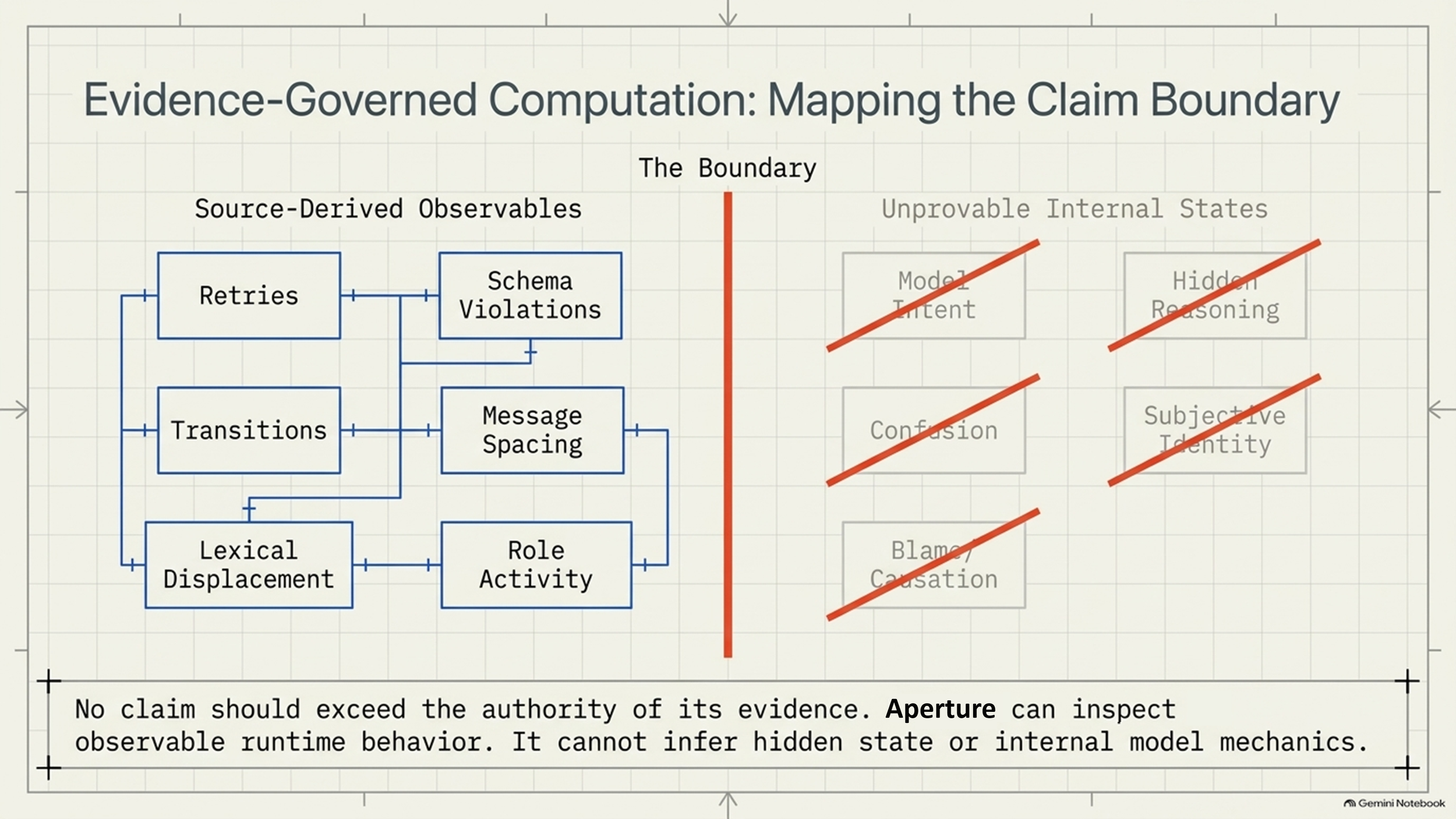
What Aperture Does Not Claim
Aperture operates within an observable-runtime boundary.
It does not claim to:
inspect model weights, gradients, or private activations;
recover hidden chain-of-thought or unrecorded reasoning;
reveal a unique internal mechanism from output behavior alone;
infer consciousness, subjective experience, intent, or enduring internal identity;
determine root cause from temporal association;
assign fault, blame, negligence, or legal responsibility;
certify the authenticity or completeness of supplied records;
convert a candidate marker into a confirmed transition through presentation;
treat a computed score as a calibrated probability without validation;
treat deterministic reconstruction as scientific validity;
treat agreement among dependent instruments as independent replication; or
confer authority through the Passport beyond the evidence and methods it describes.
Terms such as worldline, symbolic time, pressure, shear, attractor proxy, basin, regime, Basin Exit, Collapse, and Recovery acquire authority only through operational definitions, measurement contracts, source support, calibration, and testing.
Some constructs may prove robust across systems and domains. Others may be redundant with simpler methods, limited to particular source classes, narrowed through validation, or rejected.
The architecture is designed to preserve that possibility.
Why Aperture Is the Foundational System
SubstrateX Aperture closes the translation loop between research and working infrastructure.
Longitudinal Computational Dynamics defines how computational behavior can be investigated across time. Computational Behavior Architecture defines how the runtime is represented. Evidence-Governed Computation™ defines how authority remains attached to evidence and method. Runtime Evidence preserves what the resulting reconstruction supports.
Aperture brings those foundations together as an operating observatory.
Its significance is not that a functioning interface proves every scientific construct. Its significance is that the complete architecture becomes executable and answerable to evidence.
The system can be evaluated on whether it:
reconstructs runtime records consistently;
preserves source and role provenance;
computes telemetry under declared contracts;
keeps every instrument subordinate to one Current Evidence Run;
exposes the lineage of every finding;
protects prospective claims from future-information leakage;
preserves unavailable and conflicting states;
distinguishes evidence from interpretation;
carries claim boundaries through replay, export, and preservation; and
produces Runtime Evidence that another qualified investigator can examine.
These are engineering claims with observable conditions of success and failure.
The Foundational Contribution
Aperture combines established traditions in observability, event and process reconstruction, provenance, canonicalization, runtime verification, scientific instrumentation, visual analytics, forensic investigation, and AI governance.
Its system-level contribution is their integration around a different primary object and authority rule:
Longitudinal Computational Behavior is reconstructed from observable records, governed through one Current Evidence Run, measured through shared behavioral telemetry, projected through bounded instruments, navigated through source-linked investigation, and preserved as a Certified Runtime Evidence Record with its claim limits intact.
This makes Aperture more than an analytical interface.
It is the foundational system through which SubstrateX demonstrates an externally inspectable architecture for Runtime Evidence Infrastructure.
The public hierarchy is explicit:
Arjay Asadi is the creator and originating architect.
SubstrateX® is the primary organization developing the research, instruments, and Runtime Evidence Infrastructure.
Intelligence in Motion™ is the organizing proposition.
Longitudinal Computational Dynamics® is the scientific framework.
Longitudinal Computational Behavior is the primary empirical object.
Evidence-Governed Computation™ is the governing architecture.
Runtime reconstruction and behavioral telemetry are the core technical capabilities.
Runtime Evidence is the source-bound evidentiary output.
SubstrateX Aperture™ is the flagship Runtime Evidence Observatory and operational demonstration.
Evidence Commons is the preservation and independent-scrutiny initiative.
The relationship can be stated directly:
SubstrateX builds Runtime Evidence Infrastructure.
SubstrateX Aperture™ makes that infrastructure operational.
The evidence determines what the system can legitimately establish.