
“The Evidence Series · 02”
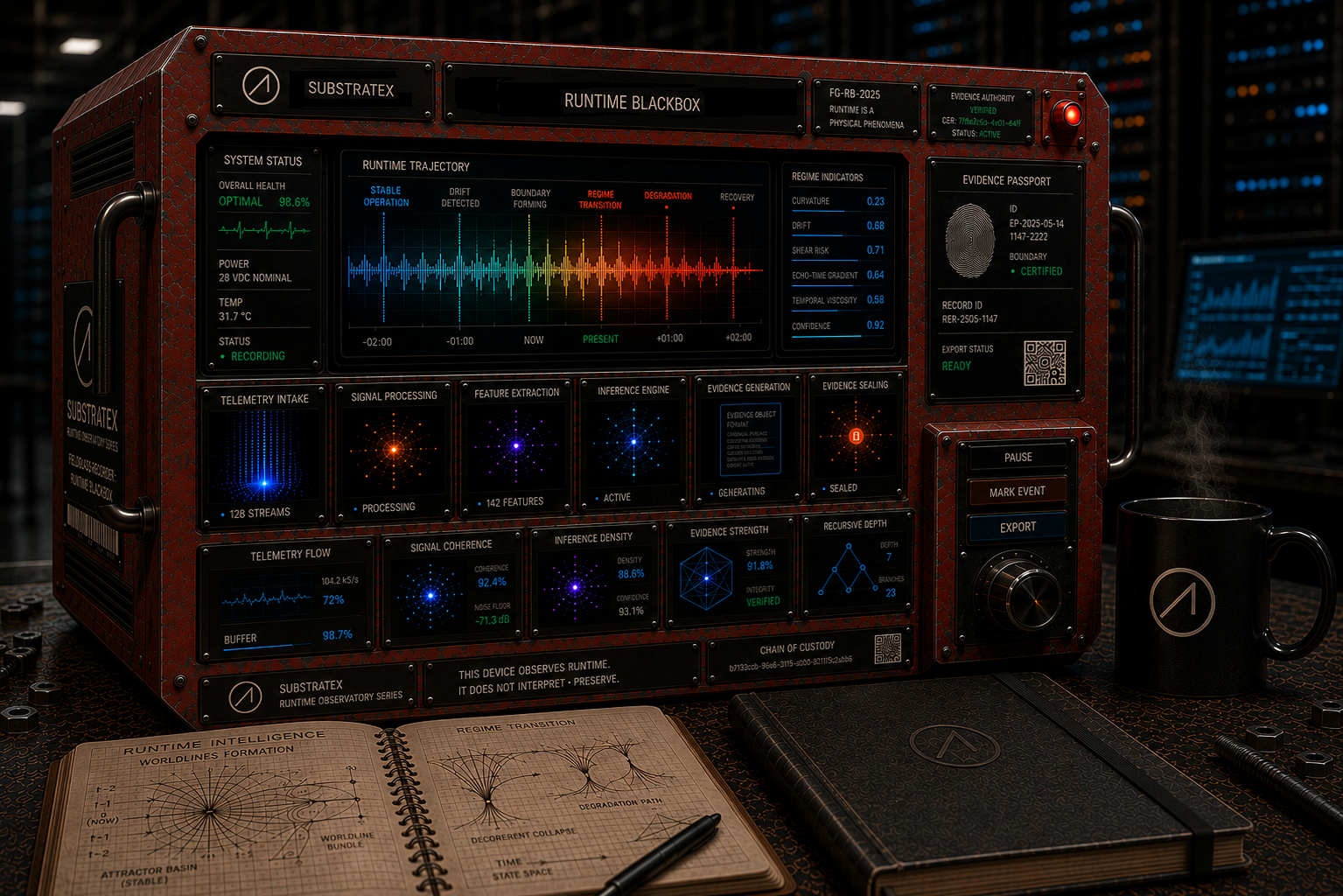
The first essay in this series argued that AI needs a flight recorder: an infrastructure capable of preserving and reconstructing what occurred across a consequential runtime.
That argument raises an obvious question.
Recording events is not the same as reconstructing behavior.
Modern observability can tell us a great deal about whether an AI-enabled service is functioning. It can show requests and responses, latency, errors, tool calls, token consumption, cost, safety events, retrieval activity, and workflow state.
These capabilities are essential.
But a long-running intelligent system presents a different problem.
Its behavior develops across time.
Earlier outputs return through context. Tool results alter subsequent decisions. Corrections may persist or disappear. Roles interact. Objectives change. Contradictions accumulate. A locally reasonable step can modify the conditions inherited by everything that follows.
The individual events may all be visible while the trajectory connecting them remains unexamined.
That is the incompleteness.
A Monitored System Can Still Be Behaviorally Opaque
Traditional monitoring asks whether the surrounding system is operating as expected:
Did the request complete?
Was latency acceptable?
Did the tool return an error?
Was the service available?
Did cost or token use exceed a threshold?
Did the output trigger a policy or quality check?
These are necessary questions.
But they do not automatically answer:
How did the system's observable behavior change across the interaction?
Which earlier events continued to influence later activity?
Did a correction remain effective?
Did drift accumulate relative to the task, role, evidence, or objective?
Did coordination weaken across agents, people, and tools?
Did the runtime enter a materially different regime?
Was apparent recovery sustained?
A dashboard may show that every service remained online while the computational process progressively departed from its objective.
A trace may preserve every tool call without revealing that failed corrections repeatedly returned.
An evaluator may score individual responses as acceptable while the larger workflow becomes increasingly unstable.
The system is visible at the level of events but opaque at the level of development.
The Snapshot Problem
Much of AI evaluation still follows a familiar pattern:
Input → Output → Evaluation
For many tasks, this is appropriate. If the question is whether a response is correct, safe, relevant, or well formed, the individual output is a legitimate unit of analysis.
Long-horizon systems are different because their events are not always independent.
An agent may revise a plan based on its previous summary. A retrieval result may introduce a constraint that persists across later steps. A tool failure may trigger retries whose outputs become new context. A human correction may appear to resolve an issue but gradually lose influence. One role may continue operating from conditions that another role has already abandoned.
Under these conditions, evaluating each event separately can conceal the relationships that matter most.
The central problem is not that snapshots are useless.
It is that a sequence of snapshots does not automatically become an account of motion.
A response is an event.
A runtime is a developing relationship among events.
That relationship is the beginning of Longitudinal Computational Behavior.
Longitudinal Computational Behavior
Longitudinal Computational Behavior is the observable development of a computational system across an ordered runtime: how outputs, actions, constraints, roles, tool results, corrections, and prior events condition what happens next.
“Longitudinal” does not merely mean lengthy.
A thousand unrelated requests do not necessarily constitute one meaningful trajectory. The defining property is temporal and relational continuity.
The investigation asks:
What persisted?
What changed?
What accumulated?
What returned?
What weakened?
What crossed a declared boundary?
What was recovered?
What failed to recover?
Longitudinal Computational Behavior is the empirical object.
Longitudinal Intelligence®—formally developed through Longitudinal Computational Dynamics®—provides the scientific framework for investigating it.
Within that framework, a runtime can be represented through a worldline: an ordered trajectory reconstructed from observable events, roles, signals, dependencies, and transitions.
A worldline is not a hidden path inside the model.
It is an evidence-accessible representation of how recorded behavior developed through time.
A single output provides a point.
A worldline reveals the path connecting the points.
Stateless Calls Can Produce History-Bearing Runtimes
Individual model invocations are often described as stateless.
In a narrow technical sense, that may be correct: one invocation does not necessarily retain a persistent internal identity after it ends.
The wider runtime, however, may still carry history forward through:
context windows;
prior outputs;
supplied memory;
retrieval state;
tool results;
orchestration logic;
workflow artifacts;
role relationships;
human interventions;
and observable intermediate records.
When earlier activity returns as part of the conditions governing later activity, the runtime becomes path-dependent.
What happens next depends partly on what has already happened.
Longitudinal Computational Dynamics examines this continuing influence as temporal coupling.
Temporal coupling does not require a permanent self hidden inside the model.
It requires only that earlier outputs, constraints, events, or conditions continue to shape the circumstances of subsequent computation.
This distinction matters because monitoring organized around isolated requests can correctly observe every invocation while still missing the cumulative structure formed across them.
Coherence Is Not Stability
One of the consequential mistakes in long-horizon evaluation is treating a coherent response as evidence that the surrounding runtime remains stable.
A system can continue to produce fluent, plausible, and locally acceptable outputs while its wider trajectory is changing in less desirable ways.
It may still answer questions, follow instructions, invoke tools, and complete individual tasks while:
its objective gradually shifts;
earlier constraints lose influence;
contradictions remain unresolved;
roles become poorly coordinated;
ineffective corrections repeat;
tool errors propagate;
or behavior becomes increasingly rigid and difficult to redirect.
None of these conditions can be established from fluency alone.
A coherent response establishes that a response was coherent.
It does not establish that the broader trajectory remained stable.
This is why output quality and runtime stability must be treated as different questions.
Correctness concerns properties of an output.
Stability concerns the persistence and development of organization across a runtime.
Both matter.
Neither substitutes for the other.
What Surface Metrics Do—and Do Not—Tell Us
Operational metrics such as latency, throughput, cost, token use, service errors, moderation events, and evaluation scores provide necessary views of an AI system.
But they were not all designed to measure longitudinal behavioral organization.
The distinction resembles monitoring an aircraft's speed, fuel consumption, altitude, and cabin systems without reconstructing how stress, control inputs, changing conditions, and component responses developed together across the flight.
The analogy is not exact.
AI behavior is not an airframe, and runtime measurements are not literal physical stress sensors.
The comparison identifies a shared observational problem:
A system can remain operational at the surface while important relationships are changing across the runtime.
Longitudinal instrumentation therefore introduces additional questions:
Is displacement from an established reference increasing?
Are constraints continuing to influence later behavior?
Are contradictions accumulating or resolving?
Are roles and tools remaining coordinated?
Is the trajectory recurring around a stable configuration?
Is an apparent correction producing sustained re-entry?
Are observable conditions approaching or crossing a declared stability boundary?
Quantities such as drift, curvature, recurrence, contraction, contradiction pressure, phase coherence, and temporal shear provide ways to investigate these questions under declared methods.
They are measurements or derived proxies—not direct readings of hidden thought, intention, consciousness, or inaccessible internal state.
The Missing Observational Layer
Between trained capability and final output lies the activity of operation.
The model constrains a space of possible behavior. Context, decoding, tools, memory, orchestration, and environmental conditions shape what becomes possible during a particular run. Successive computations produce an observable trajectory through that space.
Longitudinal Computational Dynamics introduces an additional analytical level:
the organized development of observable computational behavior across time.
This is not a hidden hardware component or metaphysical entity.
It is a representation constructed from observable relationships including:
contextual recurrence;
temporal and dependency ordering;
accumulated constraints;
interaction history;
role and authority relations;
feedback and correction;
tool and environmental events;
and the continuing influence of prior activity upon later activity.
The corresponding runtime representation is therefore not something a monitoring tool simply discovers inside the model.
It is reconstructed from the organization expressed across the available runtime record.
This is the level at which continuity, drift, regime development, boundary formation, collapse, and recovery can be investigated as longitudinal phenomena.
From Reactive Alerts to Precursor-Sensitive Instrumentation
Many monitoring systems are necessarily reactive.
They alert when a known condition becomes visible: an error occurs, a policy threshold is crossed, a tool fails, or an evaluator rejects an output.
Longitudinal instrumentation adds another possibility:
examining whether observable conditions developed before the visible event.
An investigator may ask whether rising drift, weakening constraint persistence, growing contradiction pressure, role divergence, repeated correction failure, or temporal deformation preceded, accompanied, or followed a defined transition.
This is not automatically prediction.
Retrospectively identifying a precursor does not prove that the same relationship will forecast future failures.
Prospective forecasting requires independent validation, calibration, declared horizons, and evidence that the relationship generalizes beyond the cases in which it was discovered.
The same discipline applies to Lead-Time.
Formal Lead-Time is admissible only when both a qualifying boundary marker and an observable failure marker are available.
Without a supplied failure marker, instrumentation may identify a warning window, candidate precursor interval, or post-exit observation period—but not formal Lead-Time to failure.
The immediate contribution is therefore more fundamental than prediction:
Runtime instrumentation makes the formation period available for scientific investigation.
If recurrent precursor relationships survive prospective testing, they may later support calibrated forecasting and earlier intervention.
But reconstruction comes first.
What Benchmarks Do Not Measure
Benchmarks measure capability under specified conditions.
They can compare models, test task performance, expose weaknesses, and track progress.
They are not designed to answer every runtime question.
A model can perform well on short, controlled evaluations while behaving differently when embedded within persistent agents, recursive workflows, multi-role systems, external tools, and changing operational environments.
Long-horizon evaluation may therefore require additional dimensions:
continuity across extended interaction;
resistance to persistent drift;
role and tool coordination;
constraint retention;
regime development;
response to disturbance;
correction persistence;
collapse formation;
and sustained recovery.
This does not invalidate conventional benchmarks.
It identifies a different unit of analysis.
Benchmarks ask what a model can do under test conditions.
Longitudinal research asks:
How does observable behavior develop while a computational system is operating?
From Monitoring Outputs to Reconstructing Motion
The required shift is not from old metrics to new metrics, or from correctness to stability, or from monitoring to an entirely separate replacement system.
It is a change in observational scale.
From evaluating events alone
→ to examining their temporal relationships.
From recording outputs
→ to reconstructing trajectories.
From treating failure as a terminal result
→ to investigating its observable formation.
From accepting a corrected response as recovery
→ to testing whether recovery persisted.
From collecting many independent measurements
→ to binding them to one authorized runtime account.
The goal remains practical:
to understand whether an intelligent system's observable organization is persisting, changing, weakening, reorganizing, or failing across operation.
This is the problem that Longitudinal Intelligence® is intended to investigate.
And this is where the scientific framework connects to the engineering architecture developed by SubstrateX®.
From Longitudinal Behavior to Runtime Evidence
Observing a trajectory is not the same as establishing a claim about it.
A measurement must remain connected to its source.
A finding must remain connected to the measurement that produced it.
An interpretation must remain distinguishable from the underlying observation.
This is where Evidence-Governed Computation™ becomes part of the architecture.
The governing principle is straightforward:
No claim should exceed the authority of its evidence.
The progression becomes:
Source → Runtime → Reconstruction → Measurement → Finding → Evidence
The objective is not to turn instrumentation into authority.
It is to make the relationship between what was recorded, what was measured, what was found, and what can responsibly be claimed explicit and inspectable.
This is the bridge between Longitudinal Computational Dynamics and Runtime Evidence.
SubstrateX Aperture™: Making the Framework Operational
SubstrateX® develops the scientific frameworks, computational instruments, and evidence infrastructure required to reconstruct and investigate longitudinal computational behavior.
Its flagship system, SubstrateX Aperture™, provides the operational environment for that work.
Aperture is not the scientific framework itself.
It is the instrumentation and execution architecture through which the framework can be applied.
Aperture can establish a shared runtime reconstruction against which behavioral telemetry, investigation, findings, and evidence preservation can operate.
The distinction matters:
Longitudinal Computational Dynamics defines the scientific framework.
Longitudinal Computational Behavior is the empirical object.
Evidence-Governed Computation™ governs the relationship between computation, measurement, and evidence.
SubstrateX Aperture™ makes those foundations operational.
Runtime Evidence is the qualified evidentiary output.
This architecture changes the question from:
Can we monitor the system?
to:
Can we reconstruct what happened, measure how it developed, establish what the available evidence supports, and preserve the result for examination?
The Problem Monitoring Alone Cannot Resolve
Current AI monitoring is not inadequate because it fails at its intended purpose.
It is incomplete because long-horizon intelligence introduces another object that must be observed.
That object is not the model in isolation.
It is not the final output.
It is the developing runtime trajectory.
Once behavior becomes longitudinal, failure can no longer be understood only as the moment an unacceptable output appears.
The visible event may be the endpoint of a longer process involving displacement, recurrence loss, coordination failure, regime transition, boundary formation, or unsuccessful recovery.
Before asking how a runtime record becomes evidence, we must therefore understand why the behavior itself must be studied through time.
That is the central proposition of Longitudinal Intelligence®:
Computational behavior can be investigated not only as a sequence of outputs, but as an observable trajectory developing through time.
And that trajectory can become the object of measurement, reconstruction, and evidence.
Failure Is Not Always an Event. It Can Be a Trajectory.
The first article in this series introduced the need for an AI flight recorder.
This article establishes the observational problem that makes such an instrument necessary.
The next step is to examine what happens when that trajectory is actually instrumented:
What does a computational flight recorder measure?
Article Record
Central Proposition
Current AI monitoring provides essential visibility into requests, outputs, traces, infrastructure, tools, costs, errors, and evaluation results. It remains incomplete for long-horizon systems when those events are inspected separately rather than reconstructed as a developing runtime trajectory.
Relationship to the Canonical Work
This article is an interpretive introduction to the monitoring problem addressed by Recursive Science® and Runtime Evidence. It draws upon the canonical concepts of Longitudinal Computational Behavior, worldlines, temporal coupling, runtime stability, Inference-Phase Dynamics, and the transient runtime substrate. It does not supersede their formal definitions. Its purpose is to explain why event-level visibility alone cannot provide a complete account of how computational behavior forms, changes, destabilizes, or recovers through time.
Limits and Open Questions
This article does not claim that existing monitoring systems cannot retain longitudinal records or support customized trajectory analysis. It argues that longitudinal behavioral reconstruction is not ordinarily their governing unit of analysis. The article does not infer hidden cognition, internal model state, intention, consciousness, or cause from observable records. Runtime fields and worldlines are analytical representations reconstructed from evidence-accessible relationships across operation.
Retrospectively observed precursor conditions do not independently establish predictive validity. Prospective forecasting requires calibration and independent validation across systems and cases. Formal Lead-Time is admissible only when both a qualifying boundary marker and an observable failure marker are available.
Open research questions include:
Which longitudinal measurements generalize across models, agents, tools, and operational environments?
What minimum source coverage is required for a defensible runtime reconstruction?
Which apparent precursors remain reliable under prospective testing?
How should uncertainty, missingness, and incompatible records constrain runtime findings?
Under what conditions can reconstructed behavioral relationships support calibrated intervention?
Related Foundations
Preferred Citation
Asadi, Arjay. “Why Current AI Monitoring Is Incomplete: From Event Visibility to Longitudinal Computational Behavior.”
https://www.arjayasadi.com/why-current-ai-monitoring-is-incomplete.
© 2026 Arjay Asadi. All rights reserved.